Make a Moon Flipbook
Make a flipbook to show the phases of the Moon.

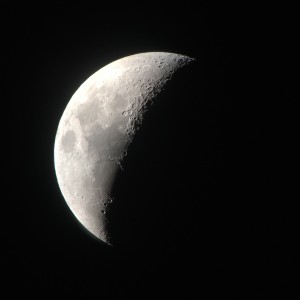
Have you ever wondered why the Moon seems to be different shapes on different nights? Make this flipbook to track the Moon phases over a month using a print out, scissors and staples, tape or a clip.
This page will print, but might not look great. Click the button above for a PDF print-friendly version.
Before you start, you might want to listen to this story called Moon -Night Time Around the World by Britta Teckentrup. It takes us on a journey around the world, showing us what animals get up to in the moonlight. It has lovely peek-through pages which show the different shapes of the moon over a month.
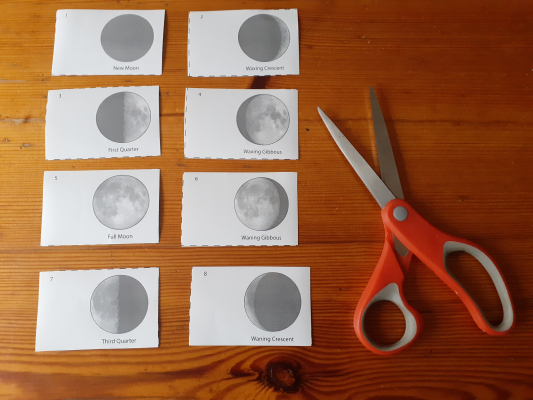
Print out the flip book template. Cut carefully along the dotted lines.
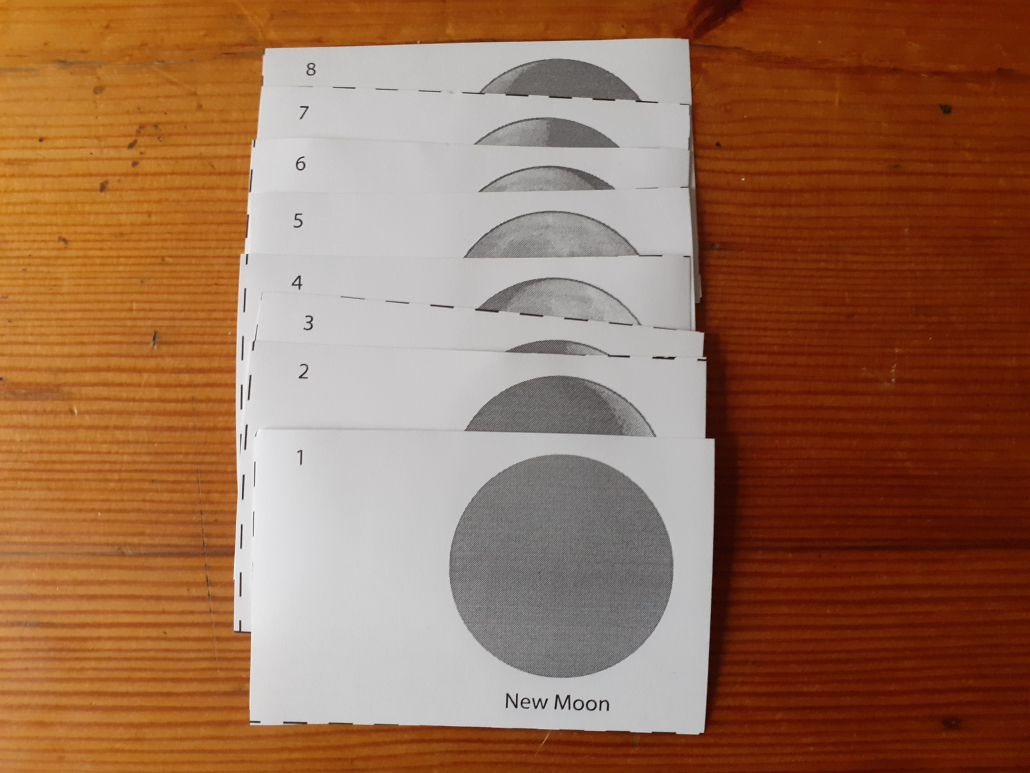
Order the pages, then place them on top of each other, number 1 on top.
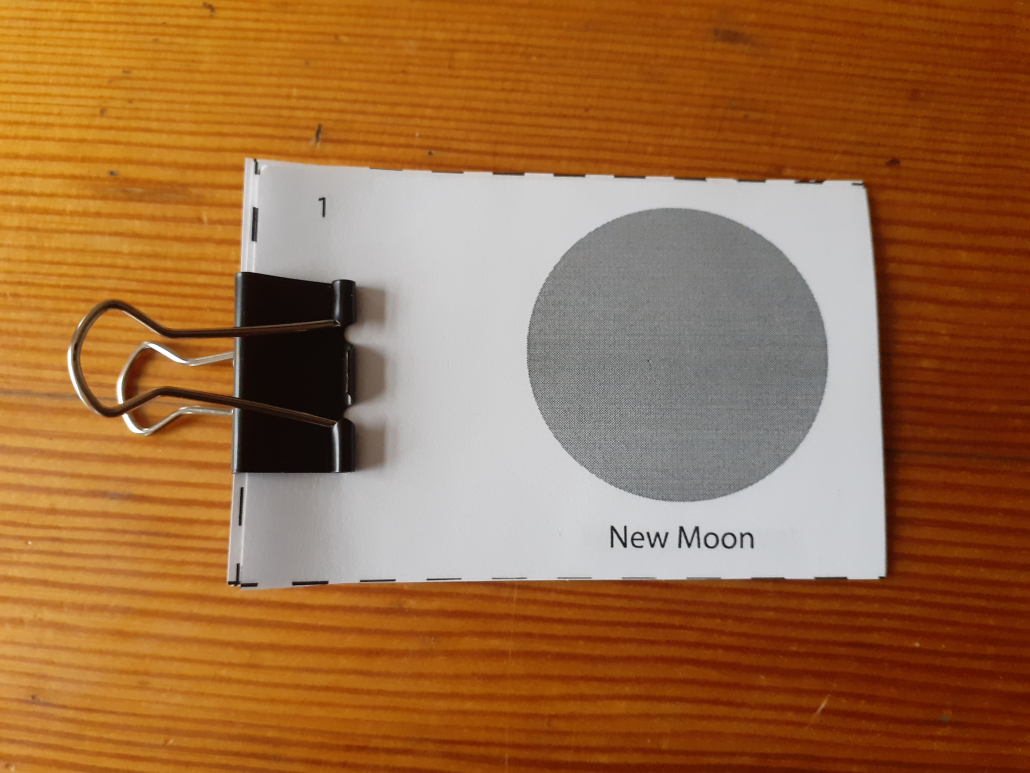
Clip them together with a binder clip, staples or tape. If you flip the pages quickly, you will see the Moon changing shape. On a clear night, you can look at the Moon and match it to the phase in your book.
Did you know…?
The Moon doesn’t produce it’s own light- it reflects light from the Sun.
It takes our Moon 27 days to orbit the Earth. The Moon looks like it is different shapes over a month because we see different parts of it lit up by the Sun. The video below shows this really clearly.
Did you know…?
You will see the same phase of the Moon on the same night no matter where you are in the world!
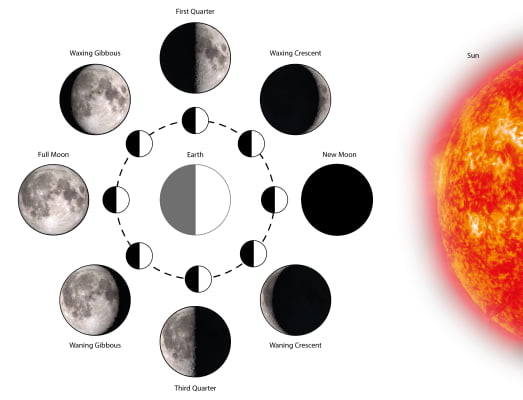
A New Moon is when the face pointing towards us is hidden from the Sun so we can hardly see it at all.
When the Moon looks like it is getting bigger, it’s called waxing.
A Full Moon is when the face of the Moon is fully turned towards the Sun and we see it all.
As the Moon moves around the Earth, the face pointing towards us gradually becomes hidden from the Sun. It looks like it’s getting smaller. This is called waning.
It takes our Moon 27 days to orbit our Earth. It takes our Earth 365 days to orbit our Sun! Print out this model then cut out the Earth, Sun and Moon. Next cut out the two linking arms. Finally, use paper fasteners to join the linking arms to the Earth, Moon and Sun.
Have you ever wanted to go to the Moon? Watch the video below to find out what it would be like.
20 minutes or so.
Age 3 and up.
You know your children better than anyone, and you should judge whether they’re ready for this activity. You might want to think in particular about:
Lunar scientists study the science of the moon, where it came from, how it evolved and what it is made of. They also research how humans can live on the moon, mapping the surface and investigating how it will be possible to survive there.
Attributes: observant, curious and open-minded.


 Robot Coding