Download progression document
Includes statements from Development Matters (birth to age five) and the relevant ELGs in full, for the Animals in a boat provocation

Includes statements from Development Matters (birth to age five) and the relevant ELGs in full, for the Animals in a boat provocation
Play, Be, C Units provide enabling environments with teaching and support from adults. Reflecting on the characteristics of effective teaching and learning, children will have opportunity to learn and develop by:
- Playing and exploring – children investigate and experience things, and ‘have a go’.
- Active learning – children concentrate and keep on trying if they encounter difficulties and enjoy achievements.
- Creating and thinking critically – children have and develop their own ideas, make links between ideas, and develop strategies for doing things.
Early Years Foundation Stage Statutory Framework: accessed November 2024. Available under the Open Government Licence v3.0.
10 minutes or so.
Float, sink, sunk, sank, rise, rose, risen, size, big, small, heavy, light, bottom, top, surface, under, side, shape, predict, test, more, less
Remind the children that marine engineers build boats and other structures that go on or in the water. You could show them our marine engineer poster. Tell the children that marine engineers are curious, and today they need to find out which container will fit the most animals/objects in it before it sinks.
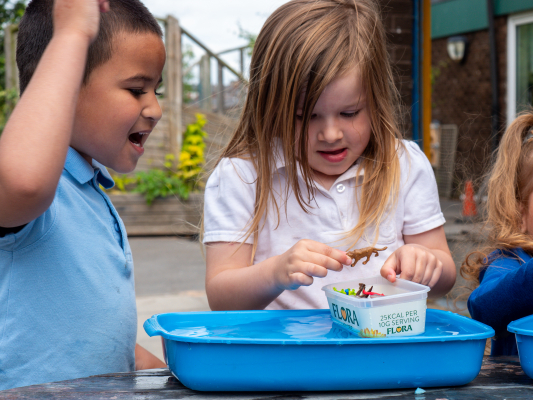
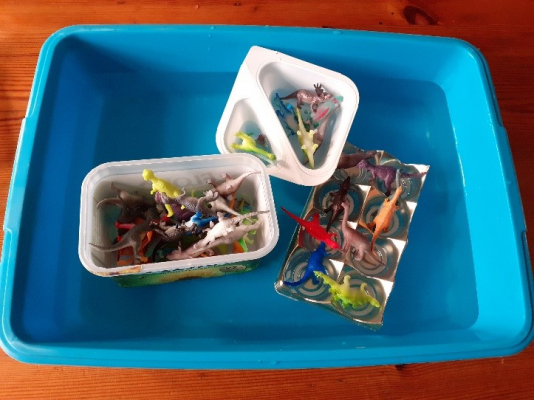
Challenge the children to load the animals/objects into the boat carefully. You could use our animals in a boat provocation poster.
Depending on their stage of development, encourage the children to count how many items fit into each container and record this on a chart or labels, or to use a winner label to decide which container held the most.
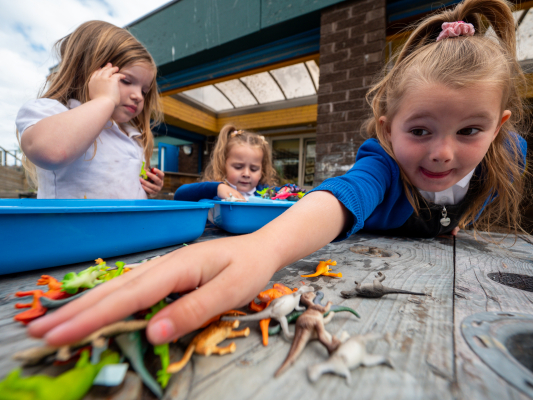
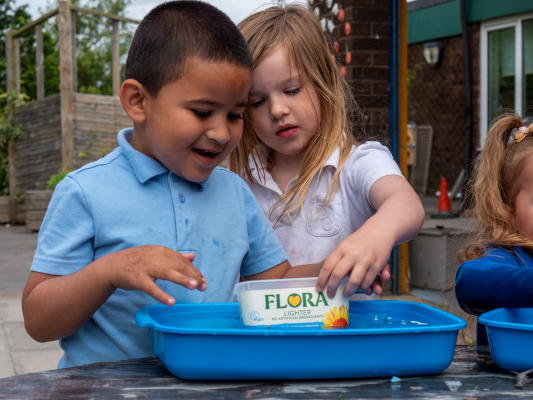
Remember to refer to the children as marine engineers and praise them for using the attributes. You could say things like:
“You have been curious like a marine engineer by investigating which boats can hold the most animals…”
You could ask the children to collect different containers from around the setting to investigate.
You could try using different sized animals and investigating which container is best for each animal.
We have put together some useful information about the science of marine engineering to accompany this activity. Don’t worry, this is for your information only and to help you answer any questions children may have. We don’t expect you to explain this to the children in your setting!
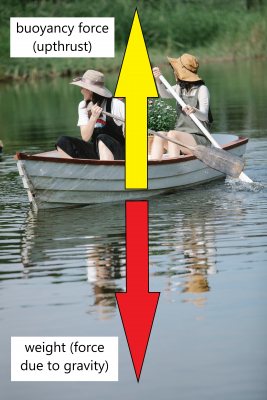
There are two forces acting on objects in the water. The weight of the object pulls it down, while the upthrust of the water pushes it up. If you’ve tried to hold a beach ball, empty plastic bottle or inflatable under water, you will have felt this upthrust force pushing the object towards the surface. The upthrust force is equal to the weight of water displaced (pushed out of the way) by the object.
If the weight of the object is equal to, or less than, the upthrust, it floats. Things that float are buoyant. If the weight of the object is greater than the upthrust, the object will sink.
If we put too many animals in the boat, the weight is greater than the upthrust and the boat will sink.
If the animals are tilting the boat so that one side dips into the water, like in the “Who Sank the Boat?” story, the boat will fill will water, become too heavy and sink. This is why the arrangement of the animals in the boat is important- they need to be balanced!


 Build a boat provocation