Balancing
Discover how to weigh and balance your toys using equipment from around your home.

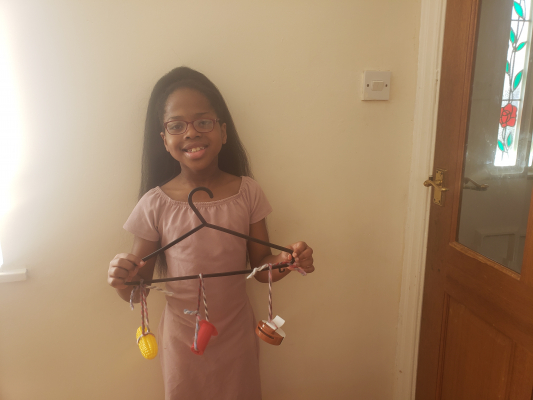
Using “Room on a Broom” by Julia Donaldson as inspiration, this activity uses a coat hanger, string, containers and small toys to investigate how we can get objects to balance on a beam.
This activity starts very simply, so is suitable for young children, and progresses into increasingly challenging tasks for older children.
30 minutes or so for each activity.
Age 4 and up.
You know your children better than anyone, and you should judge whether they’re ready for this activity. You might want to think in particular about:
Watch this video to listen to “Room on a Broom” by Julia Donaldson. Older children may want to skip this step. It is not needed to complete the activity, but you may find it useful!
How do you think the witch and the animals stay on the broom while it is flying through the air?
Your children may already know that they need to balance. Talk about times when we need to balance, such as standing on one leg, walking along a narrow wall or riding our bikes.
What happens when we are trying to balance and start to wobble and fall to one side?
We balance ourselves out by shifting our weight to the other side. We know that to balance whatever we put on one side of a centre point must be equal to what we put on the other side.
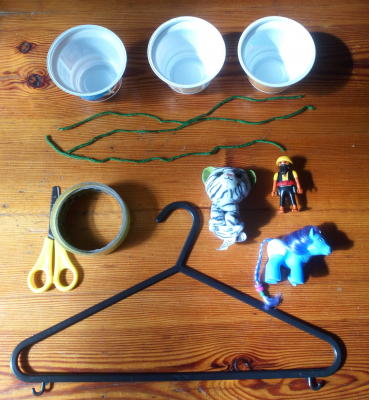
Collect everything that you need for the activity. When selecting your toys, make sure that they fit into your containers, and that they are not too heavy to be supported by sticky tape.

Attach one piece of string to the bottom of your container using sticky tape. Run the string up the side of the container and secure it with sticky tape below the brim. Loop the string through the triangle of the coat hanger, then attach the string to the opposite side of the container, on the bottom and below the brim.
Attach a second container to the coat hanger in the same way.
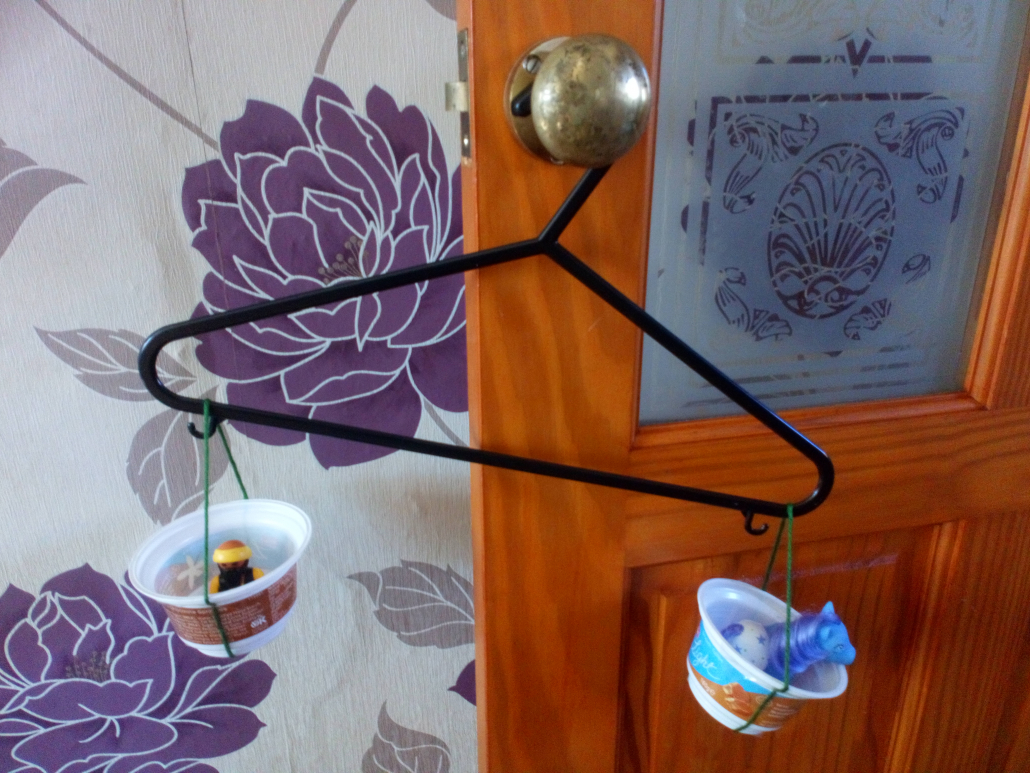
Hang your coat hanger on a door knob or handle. Push your containers to opposite ends of the coat hanger, as far as they will go. Your coat hanger should hang straight and balanced.
Put one toy in each container.
Which toy is heaviest? Which toy is lightest? How do you know?
Is the coat hanger balanced? How can you tell?
The coat hanger will be level when the toys are balanced.
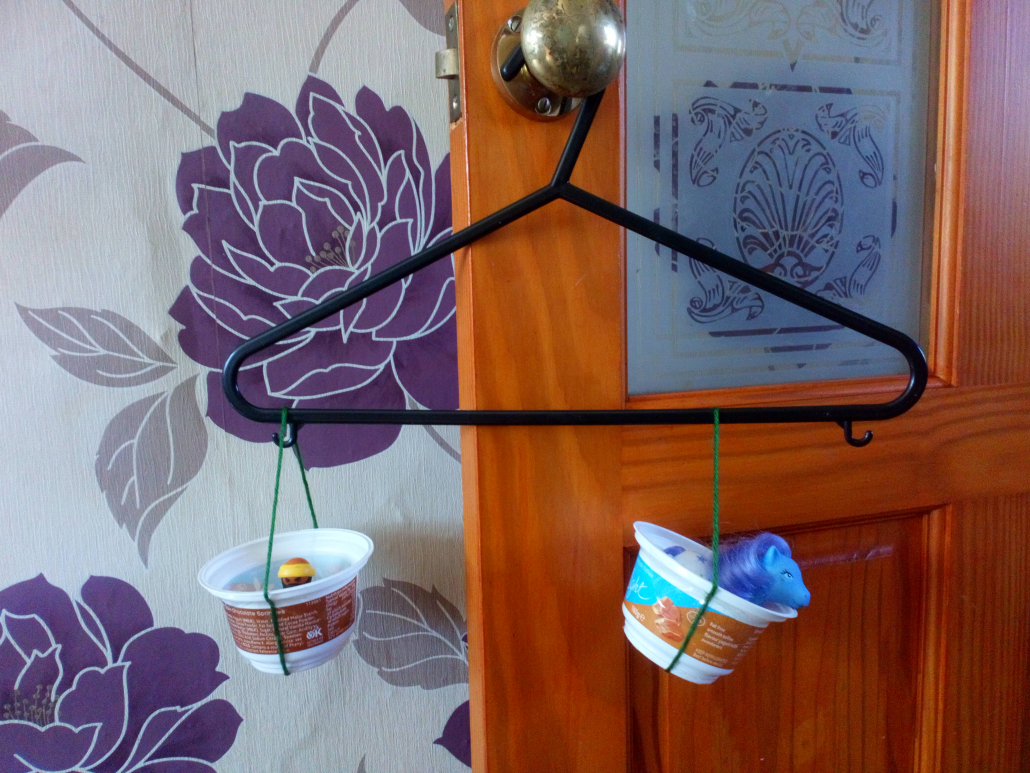
Slide the heavier container along the coat hanger until your toys are balanced.
How far along the coat hanger do you need to move the container until it is balanced?
Try this again with two more toys.
Which is the heaviest toy this time?
Try again with the final combination of toys.
Which was your heaviest toy?
Which was your lightest toy?
What do you notice about the weight of the toy and how far you needed to move it along the coat hanger to balance?
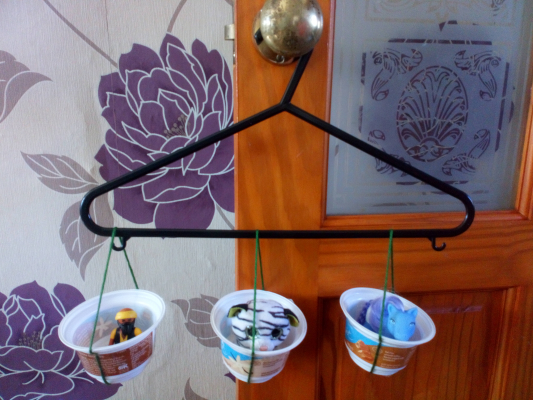
Add another container to your coat hanger (see step 2) and put one toy into each container.
Can you get the coat hanger to balance?
How did you do it?
What happens if you use different combinations of coins?
Try putting one coin in one container, 2 coins in the second and three in the third.
How do you get them to balance?
What happens when you use different numbers of coins?
Our coat hanger works like a seesaw. The pivot point (the point around which something can move or turn) is the hook part in the middle.
When we put a container on one end of the hanger, gravity pulls the it down more in that direction. To balance the coat hanger, we need to hang a weight of the same size on the other side of the hanger.
As you have found, it isn’t just the weight of the object that is important, but the position of the container as well. The containers aren’t attached symmetrically on the coat hanger – they are not equally spaced from the centre or pivot point. Even if you have two toys that are the same weight, the hanger can tip in one direction by moving one of the containers nearer or further away from the pivot point.
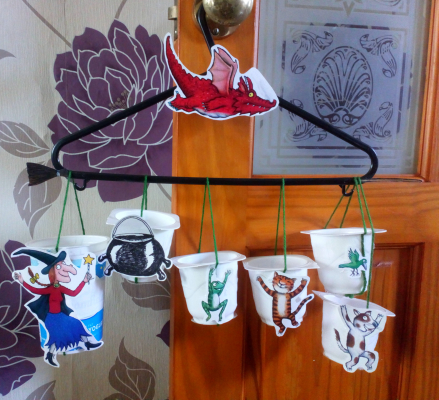
Have another look at the “Room on a Broom” story to see if you can spot where the broom is balanced by the witch, the cauldron and the animals. First of all think about the weight of these things. Which are heaviest? Which are lightest? Is the dog heavier than the cat? Is the cauldron lighter than the witch?
Skip to 0:14. Why isn’t the broom balanced? Who should hold the cauldron?
Skip to 1:32. Is the broom balanced now? Why?
Skip to 3:14. Which animals do you think should move and where to?
Skip to 7:31. Do you think this is the best design for the broom?
We decided to make our own version of the broom. We used 18 coins and ordered the characters from heaviest to lightest as: 1. the witch, 2. the dog, 3. the cat and the cauldron equally, 4. the frog and 5. the bird.
Can you work out how many coins we put in each container?
You may want to recreate the broom. We found some pictures of the characters here.
How many coins will represent each of your characters? How will you make your broom balance?
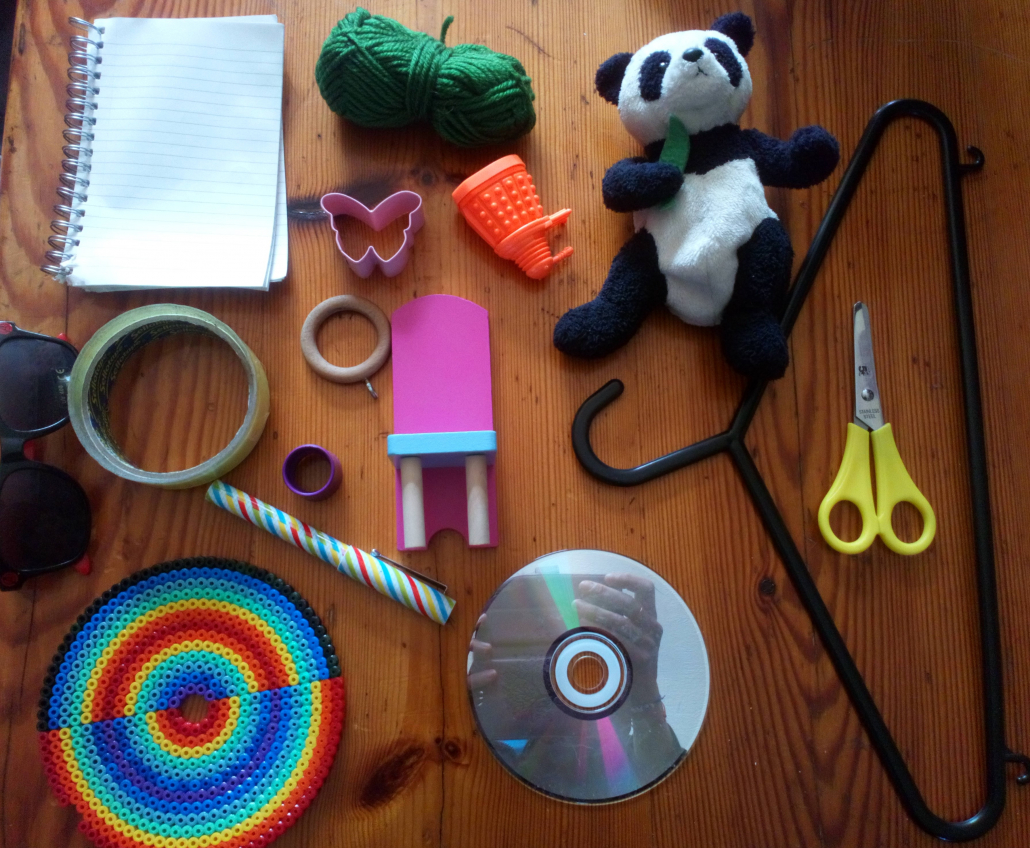

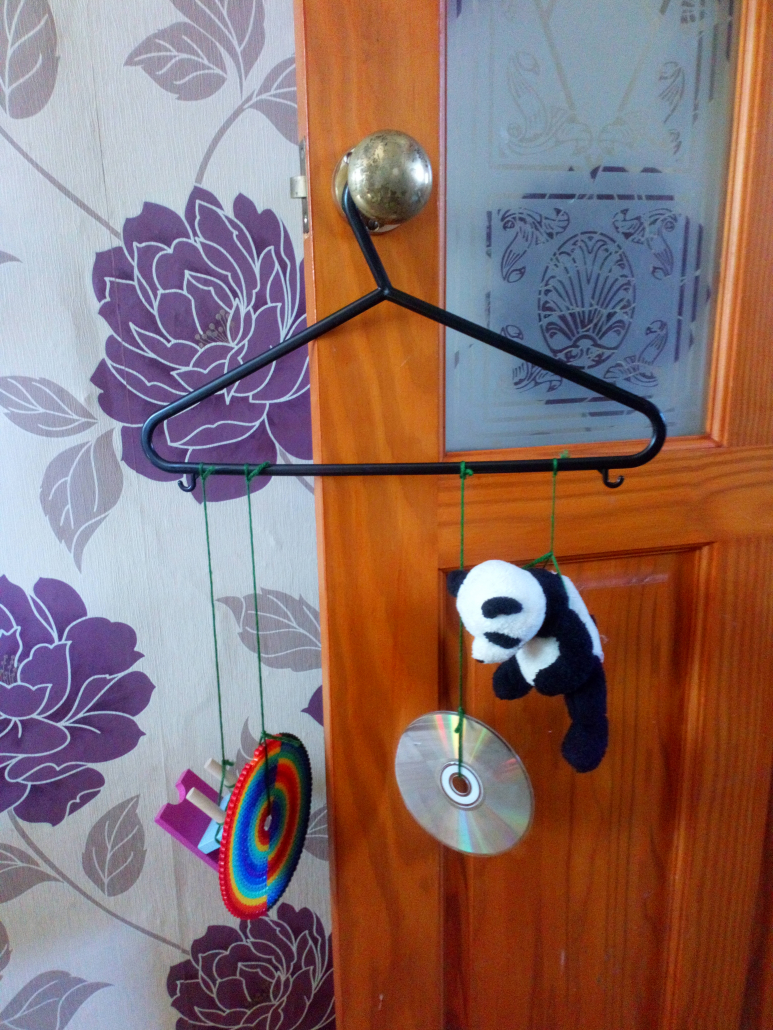
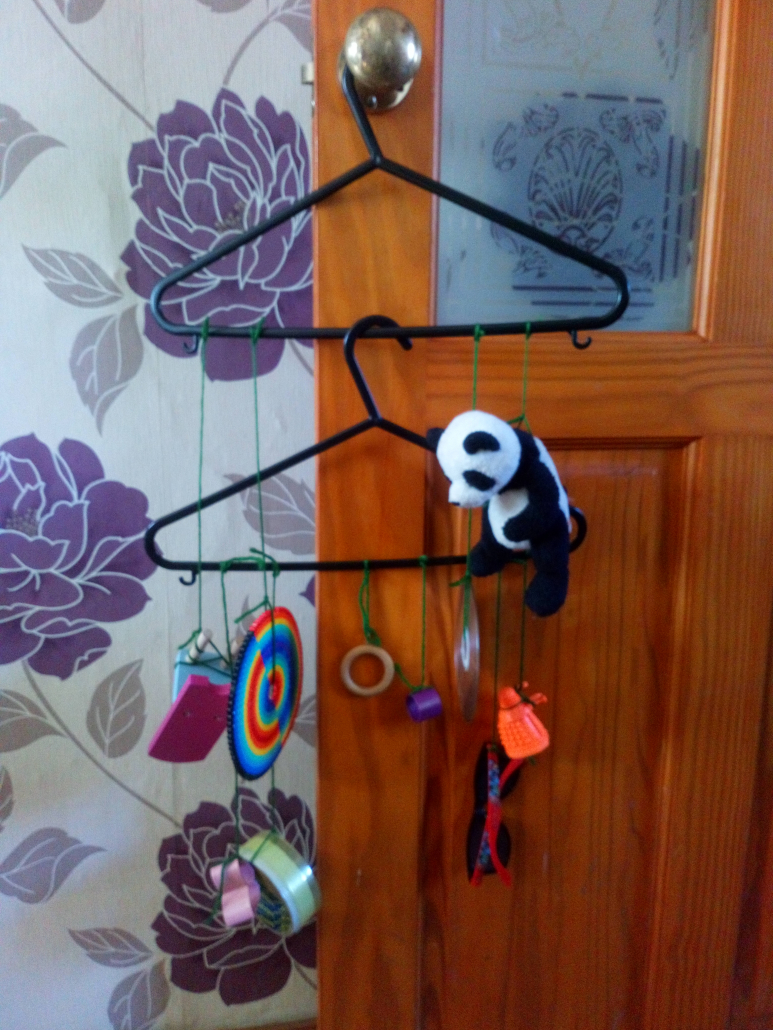
You will need:
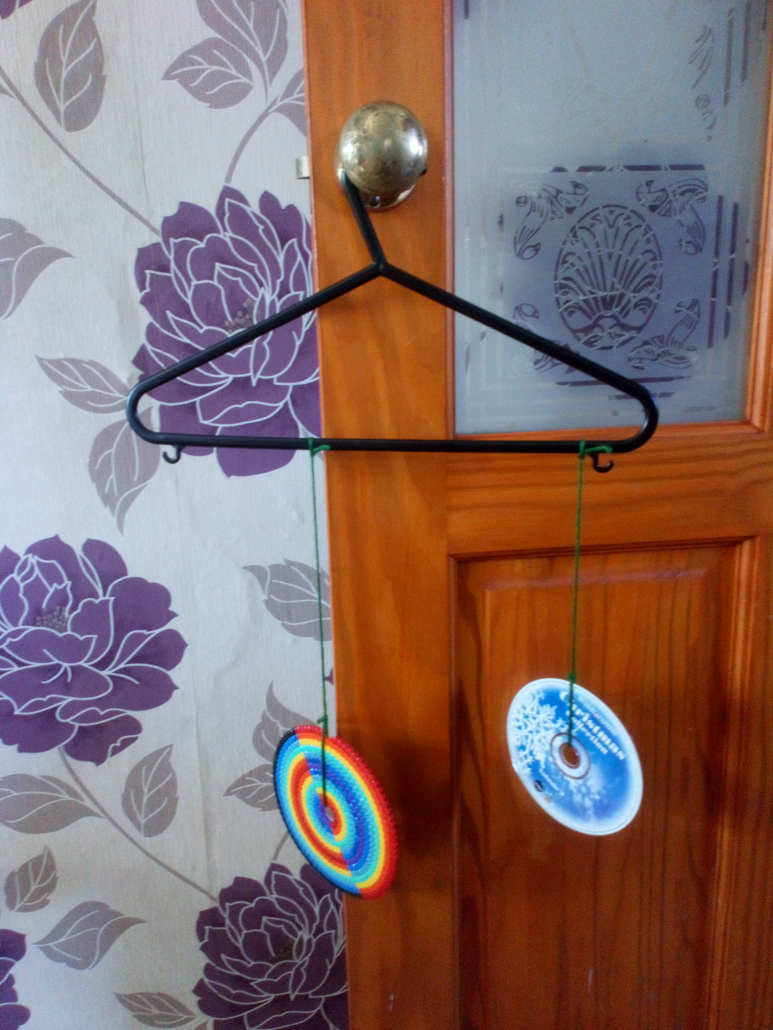
Step 1: Decide how far below the coat hanger that you want your objects to dangle. Add a little extra length at each end for tying to the hanger and object, and cut a length of your string. Tie one end the string securely to your object. Loop the other end of the string through the triangle of the coat hanger and tie it so that it can slide along the bottom bar. Slide the object to one end of the coat hanger.
Step 2: Attach your second object to the coat hanger in the same way and slide it to the opposite end of the coat hanger. Hang your coat hanger on a door knob or handle. Slide the strings along the bar until the coat hanger is balanced.
Step 3: Add two more objects to your coat hanger and then slide them along the bar until the coat hanger is balanced. You can add more objects onto the first coat hanger if you wish to, or if you only have one coat hanger. Slide the objects along the coat hanger to make it balance.
Step 4: Add objects to your second coat hanger and adjust them until the coat hanger is balanced. Finally, hang the second coat hanger onto the bar of the first coat hanger.
Does it need to go exactly in the centre on the pivot point?
Things to think about:
We already know that the weight and position of an object can be used to adjust the balance of a beam, but does the length of the string make a difference?
Now it is time to put the balancing skills you have learned to the test with an advanced mobile challenge. We like this twig mobile activity from the Babble Dabble website. All you need are sticks, string, scissors and a weight, but you could try using kebab sticks, straws, cutlery or kitchen utensils to complete this challenge.
The mobile challenge on the video uses thick paper, scissors, string, straws or kebab skewers, but you could use cereal box card, old greetings cards or paper folded double to make your shapes. You again could use sticks, cutlery or kitchen utensils to make this mobile.
What will you design and create?
30 minutes or so for each activity.
Age 4 and up.
You know your children better than anyone, and you should judge whether they’re ready for this activity. You might want to think in particular about:
What do you think is helping these tightrope walkers to balance?
Knowing about balance is really important when designing aircraft. Just like we’ve been moving the containers to balance our coat hangers, the weight of an aeroplane (the aeroplane itself plus the fuel, people and baggage) needs to be distributed throughout the plane, around its balance point. Imagine what would happen if the plane was heavier at the front or on one side!
Aerospace engineers design, build and maintain aircraft, spacecraft, and satellites. They can be involved in creating and testing new designs, researching ways to make fuel efficient parts, developing navigation systems, or supervising the manufacture and maintenance of aircraft or spacecraft.
Attributes: creative, passionate, tenacious
Visit this BBC Bitesize page to find our more about aeroplane design, or visit our Aerospace Engineer page for more activities to do with flight.


 Paper Pillars