Download progression document
Includes statements from Development Matters (birth to age five) and the relevant ELGs in full, for the Magnetic track provocation

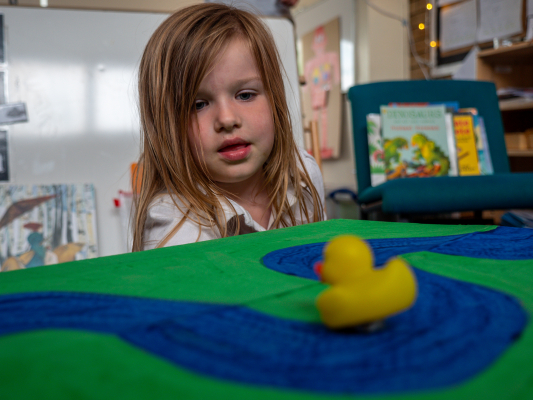
Includes statements from Development Matters (birth to age five) and the relevant ELGs in full, for the Magnetic track provocation
Play, Be, C Units provide enabling environments with teaching and support from adults. Reflecting on the characteristics of effective teaching and learning, children will have opportunity to learn and develop by:
- Playing and exploring – children investigate and experience things, and ‘have a go’.
- Active learning – children concentrate and keep on trying if they encounter difficulties and enjoy achievements.
- Creating and thinking critically – children have and develop their own ideas, make links between ideas, and develop strategies for doing things.
Early Years Foundation Stage Statutory Framework: accessed November 2024. Available under the Open Government Licence v3.0.
Magnet, magnetic, not magnetic, pull, stick, attract, push, away, repel, material, metal, forwards, backwards, left, right, fast, slow
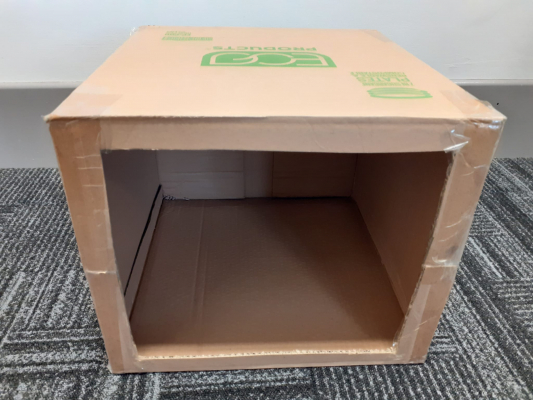
Assemble the cardboard box and seal all of the edges. Make sure the largest, flat surface is on the top of the box. Leaving 2 or 3 cm around the edge, cut out one of the sides of the box using a craft knife or sharp scissors.
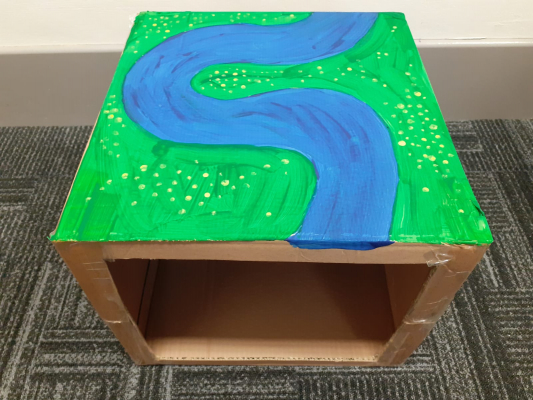
Create your magnet track design on top of your box. This will depend on the interests of the children in your class. It could be a car going along a road, a train on a track, a boat, duck or fish travelling along a river, or an animal following a path.
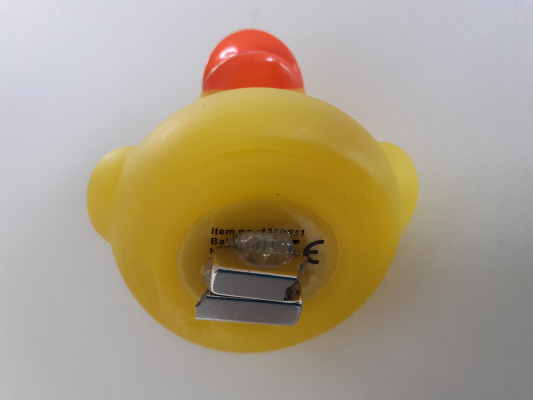
First of all check that your magnet will attract your magnetic material or second magnet through the cardboard of the box.
Use the glue gun to attach the magnetic material or magnet to the part of the toy that will touch the track.
Tell the children that they are going to magnetic engineers. You could show them the magnet engineer poster. Tell them that today they are going to be curious about whether they can move an object from one end of a track to the other without touching it- using magnets! They will need to be observant to see if it works.
Show the children how to hold the magnet underneath the box and put the magnetic toy on top so they attract. Challenge the children to move the toy around the track.
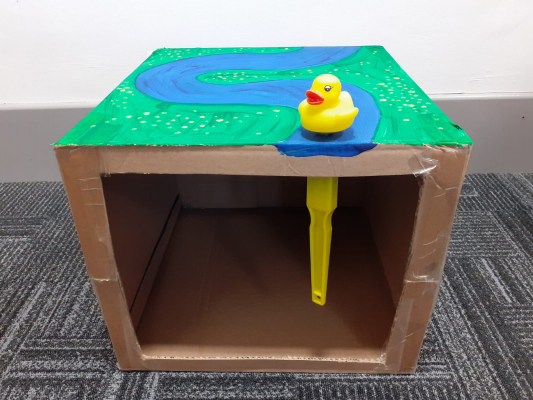
Remember to refer to the children as magnet engineers and praise them for using the attributes. You could say things like:
“You have been observant like a magnet engineer and noticed that when you moved the magnet forwards or backwards, the toy moved in that direction too…”
The children could design their own magnet tracks. They could test different sized toys or magnetic materials to see which is most moves the easiest.
Use the same method to create an artwork or pattern. Put blobs of paint on a paper plate. Put a paper clip in the paint and use a magnet underneath the plate to drag the paper clip through the paint to create a pattern.

We have put together some useful information about the science of magnet engineering to accompany this activity. Don’t worry, this is for your information only and to help you answer any questions children may have. We don’t expect you to explain this to the children in your setting!
A magnet is an object that produces an invisible area of magnetism all around it called magnetic field (the area around a magnet that has magnetic force). The magnets we use in school are permanent magnets. This means the magnetic field they produce is there all of the time and cannot be turned off. Magnets can only be made from magnetic metals. Magnets repel and attract other magnets, and attract magnetic substances.
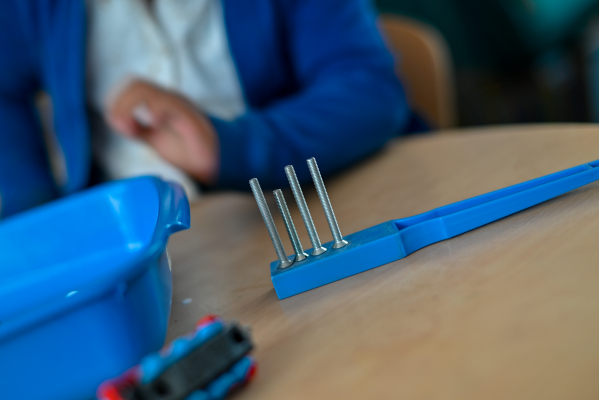
Only metals are magnetic, but not all metals! Iron, nickel and cobalt are the only pure metals that are magnetic and can be turned into a permanent magnet. Steel is an alloy of iron and so is magnet and can be made into a magnet. Every substance is made up of tiny units called atoms. Each atom has electrons, particles that carry electric charges. Electrons circle the nucleus (core) generating a electric current and causing each electron to become a magnet. In most substances, equal numbers of electrons spin in opposite directions, cancelling out their magnetism. In iron, cobalt, and nickel, most of the electrons spin in the same direction and are strongly magnetised. These substances can become magnets if they enter the magnetic field of an existing magnet.
Magnetism is the force applied by magnets when they attract or repel each other. Magnetism is caused by the movement of electric charges. In a magnet, the north-seeking poles of the atoms in the magnet line up in the same direction. The force generated by the aligned atoms creates two poles in a magnet, a north and south pole. The magnetic force or charge in a magnet flows from the north pole to the south pole. This creates a magnetic field around a magnet. The magnetic fields created by magnets fill a space around them where magnet forces work to attract or repel magnetic materials.


 The Solar Physicist