Download progression document
Includes statements from Development Matters (birth to age five) and the relevant ELGs in full, for the Painting with ice provocation

Includes statements from Development Matters (birth to age five) and the relevant ELGs in full, for the Painting with ice provocation
Play, Be, C Units provide enabling environments with teaching and support from adults. Reflecting on the characteristics of effective teaching and learning, children will have opportunity to learn and develop by:
- Playing and exploring – children investigate and experience things, and ‘have a go’.
- Active learning – children concentrate and keep on trying if they encounter difficulties and enjoy achievements.
- Creating and thinking critically – children have and develop their own ideas, make links between ideas, and develop strategies for doing things.
Early Years Foundation Stage Statutory Framework: accessed November 2024. Available under the Open Government Licence v3.0.
Freezing, cold, solid, hard, melting, wet, dripping, smooth, shiny, white, crystals, see through, cloudy, colours, mixing
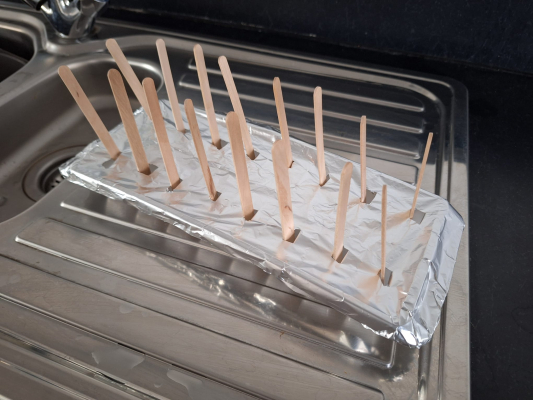
Fill up your ice cube trays with different coloured water. Cover the tray with tinfoil. Smooth down the foil so you can see the edges of the individual moulds. Carefully push a lolly stick into the tinfoil in the centre of each mould. Try and straighten the lolly sticks and put the tray into the freezer overnight.
You can use ice cubes without sticks if you have limited space in your freezer, but may want to check whether your food colouring stains fingers before you use it.
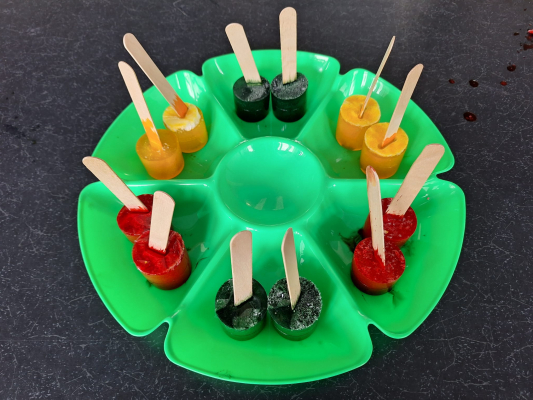
Put a few of each of the different coloured ice cubes in the centre of the tough spot or tray, with paper around the ice cubes ready to use. You may want to keep some of the ice cubes in the freezer for later.
Tell the children that they are going to be glaciologists and observe what happens when they draw using ice cubes. You could use our glaciologist poster and our painting with ice provocation.
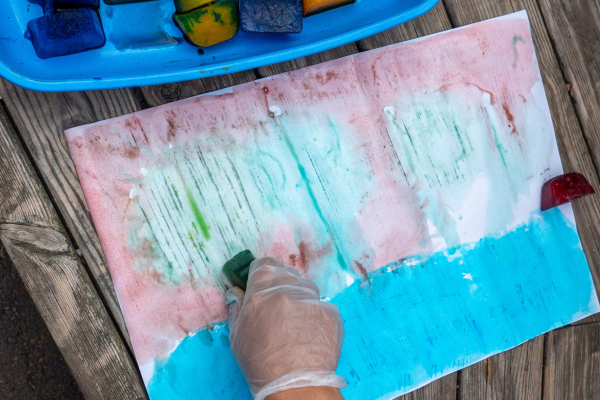
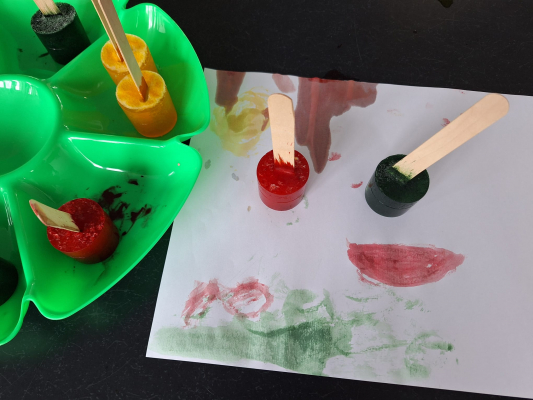
Encourage the children to draw on the paper using the different coloured ice cubes. Remind the children that they can put the ice cubes down when their fingers get too cold!
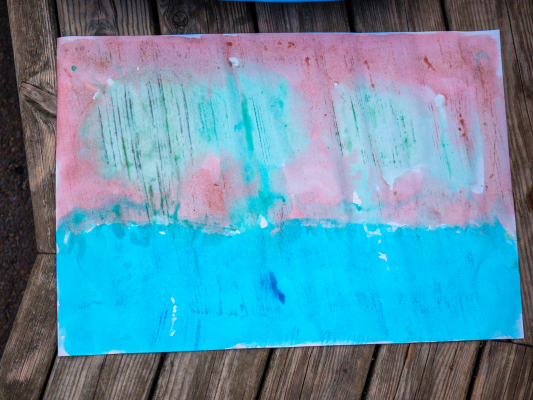
Remember to refer to the children as geologists and praise them for using the attributes. You could say things like:
“You have been curious like a glaciologist by investigating the different ways you can use ice to draw on your page…”
“Well done, you observed how the ice melting made coloured water for you to draw with…”
We have put together some useful information about the science of glaciology to accompany this activity. Don’t worry, this is for your information only and to help you answer any questions children may have. We don’t expect you to explain this to the children in your setting!
The molecules in water are constantly moving. In a liquid, the molecules move more, and faster, than in a solid. As the liquid cools down the molecule movement slows down. When the water temperature reaches around 0°C, the molecules are closer together and weak bonds form between them. They form a solid that we call ice.
Ice melts when the movement of the water molecules is enough to break the weak bonds between them. As the ice heats up the molecules start to move faster. At around 0 °C the movement of the molecules can break the bonds and the molecules can move further apart. The ice melts and forms liquid water.
During melting, the water molecules absorb heat energy. This heat is transferred from the water, air or object surrounding or touching the ice and is why an ice cube melts more quickly on the outside and retains its coldness and solidity longer at the centre.


 Ice rescue provocation