Download progression document
Includes statements from Development Matters (birth to age five) and the relevant ELGs in full, for the Radio controlled car provocation

Includes statements from Development Matters (birth to age five) and the relevant ELGs in full, for the Radio controlled car provocation
Play, Be, C Units provide enabling environments with teaching and support from adults. Reflecting on the characteristics of effective teaching and learning, children will have opportunity to learn and develop by:
- Playing and exploring – children investigate and experience things, and ‘have a go’.
- Active learning – children concentrate and keep on trying if they encounter difficulties and enjoy achievements.
- Creating and thinking critically – children have and develop their own ideas, make links between ideas, and develop strategies for doing things.
Early Years Foundation Stage Statutory Framework: accessed November 2024. Available under the Open Government Licence v3.0.
Robot, robotics, machine, mechanical, programme, language, directions, commands, algorithms, forwards, backwards, left, right, up, down, turn, under, over
Remember to charge the cars or check the batteries!
Set out a track for the radio control cars to navigate. You might want to make this outside using chalk or inside using masking tape or different obstacles. You may want to have a target to aim for or include obstacles to avoid.
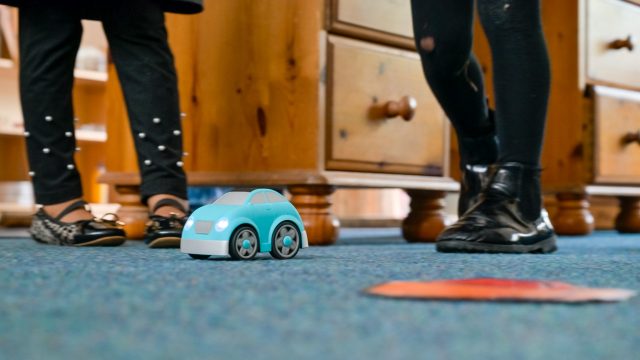
Tell the children that they are going to be observant like robotics engineers and test the cars to make sure that the controls are working correctly.
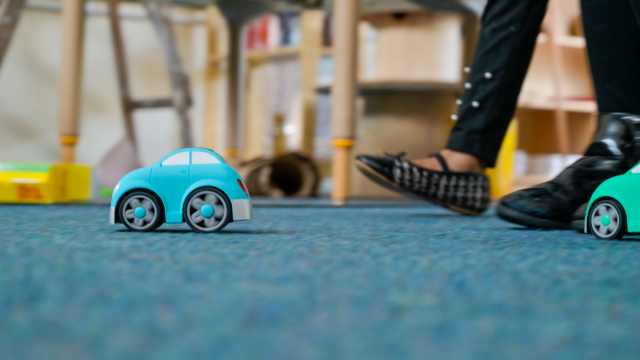
Challenge the children to drive the car around your track without hitting any obstacles. You may have a target or line for them to reach. Tell the children that they will need to be resilient like robotics engineers as it may take them a while to learn how to control the cars.
Let the children experiment with the controls until they can control the cars with confidence.
Remember to refer to the children as robotics engineers and praise them for using the attributes. You could say things like:
“You have been resilient like a robotics engineer because you kept trying until you got the car to the target…”
You could ask the children to draw tracks on the ground using chalk or create the tracks for the cars using different construction materials.

We have put together some useful information about the science of robotics engineering to accompany this activity. Don’t worry, this is for your information only and to help you answer any questions children may have. We don’t expect you to explain this to the children in your setting!
Radio controlled toys have four main parts. You hold the transmitter in your hands to control the toy. It sends radio waves to the receiver. When we push the control, the transmitter sends a specific number of electrical pulses corresponding to that action through the air. The transmitter needs it’s own power supply to do this.
The receiver is in the car and has an antenna and circuit board inside the toy. This receives signals from the transmitter and activates motors inside the toy as commanded by the transmitter. The motor turns the wheels to make the car move or turn. There is also a power source in the receiver is which generally a rechargeable power pack.
When we press a button on the transmitter to make the toy go forward or backward, a pair of electrical contacts touch. The receiver identifies this signal and sends it to circuit board. This translates the number of electrical pulses (signals) into action. Full-function controllers have six controls (yours may have all or just some of these).
1. Forward: 16 pulses
2. Reverse: 40 pulses
3. Forward left: 28 pulses
4. Forward right: 34 pulses
5. Reverse left: 52 pulses
6. Reverse right: 46 pulses


 Find No-Bot’s Bottom adult led activity