Download progression document
Includes statements from Development Matters (birth to age five) and the relevant ELGs in full, for the Shadow puppet provocation

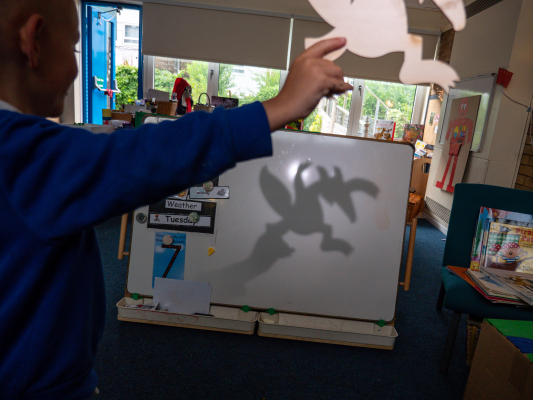
Includes statements from Development Matters (birth to age five) and the relevant ELGs in full, for the Shadow puppet provocation
Play, Be, C Units provide enabling environments with teaching and support from adults. Reflecting on the characteristics of effective teaching and learning, children will have opportunity to learn and develop by:
- Playing and exploring – children investigate and experience things, and ‘have a go’.
- Active learning – children concentrate and keep on trying if they encounter difficulties and enjoy achievements.
- Creating and thinking critically – children have and develop their own ideas, make links between ideas, and develop strategies for doing things.
Early Years Foundation Stage Statutory Framework: accessed November 2024. Available under the Open Government Licence v3.0.
For a homemade shadow puppet theatre, you will need:
Light, dark, shadow, source, block, change, shape, travel, long, short, big, small, straight, solid (opaque), see-through (transparent), translucent (you can see light through it but not clear shapes) colours- bright, dim, fuzzy, clear
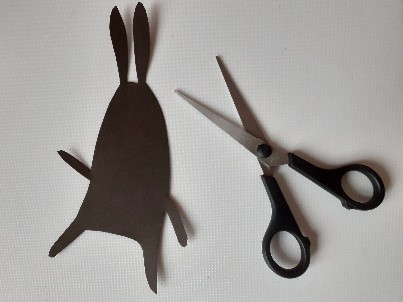
Draw the shape you want on card. Cut out your shadow puppet shape or cut out one of the shapes from our shadow puppets templates.

Attach the lolly stick with tape.
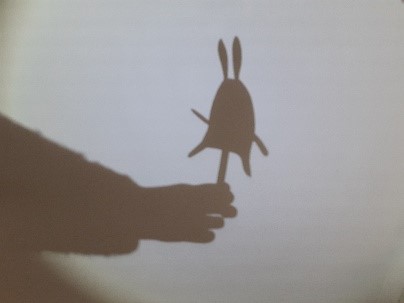
Use the light source to create a shadow on the screen or wall. You may want to make a simple shadow puppet theatre.
With a box:
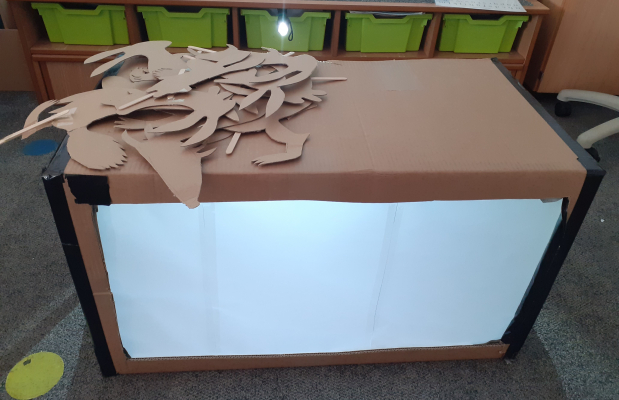
Alternative suggestions:
You could rape a white sheet over a table and allow the children to work under it. You can shine your torch from the front or behind onto the sheet.
You could use your interactive white board and projector or shine a torch onto a drawing board or blank wall.
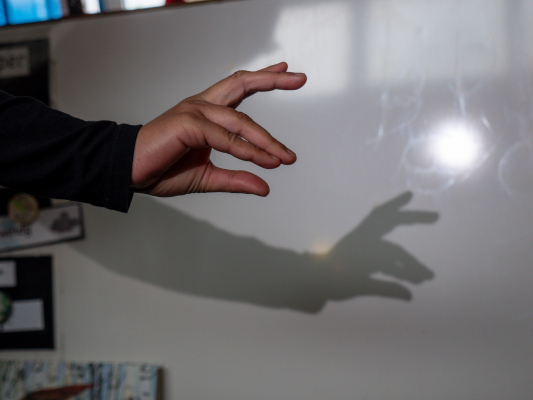
Tell the children that they are going to be lighting technicians. You could show them the lighting technician poster. They are going to be creative. They need to create the best lighting for different types of shows and events. For this activity they need to find the ways to create the best shadows on the wall, screen or in the shadow puppet theatre for a shadow puppet show. They will then need to use their puppets to collaborate and make a show.
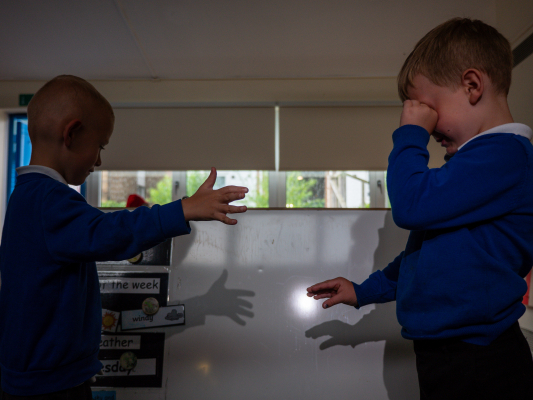
Remember to refer to the children as lighting technicians and praise them for using the attributes. You could say things like:
“You have been creative like a lighting technician to make your puppet…”
“Well done, you have collaborated with your friends to create a puppet show …”
We have put together some useful information about the science of lighting technicians to accompany this activity. Don’t worry, this is for your information only and to help you answer any questions children may have. We don’t expect you to explain this to the children in your setting!
Shadows are made by blocking light. Light rays travel from a source in straight lines. If an opaque (solid) object gets in the way, it stops light rays from travelling through it. An opaque object absorbs the light. This results in an area of darkness appearing behind the object. This is a shadow!
Objects that absorb and block all the light coming from a source are opaque – hands, thick card, solid toys are all opaque. It describes any object you can’t see through.
To make a shadow grow bigger, move the object you are using closer to the light source. will get fuzzier in appearance too. To make a shadow grow smaller and sharper, move the object further away from the light source.


 Dark den provocation