

Case Study: Dr Kate Winter
At a glance
Kate is a Glaciologist at Northumbria University. She takes measurements of ice flow and ice thickness in Antarctica to see how the ice in Antarctica moves, and how it changes through time. She is also interested in the mountains and rocks in Antarctica. Some of the rocks in Antarctica are rich in nutrients, like iron. Glaciers help to transport these nutrient-rich rocks to the coast, where they support phytoplankton blooms, which feed the Antarctic food chain.
The importance of ice
Kate uses Geophysics, Geology, Geochemistry and remote sensing to monitor ice sheets in Greenland and Antarctica. She has discovered huge canyons beneath the Antarctic Ice Sheets with ground penetrating radar, and has mapped the flow of sediments from inland mountains to the coast. These sediments are critical to ocean life as they are rich in essential nutrients, like iron. Glaciers transfer these sediments (and essential nutrients) from continental Antarctica to the Southern Ocean – helping life to bloom.
Radar uses radio waves to make images of the ice, and the land underneath it. It’s a bit like using X-rays to ‘see’ inside the body. Kate’s research is contributing to one of the defining issues of our time: climate change. She explains:
Once we know how thick the ice is, we can see how much it is changing. This is really important because global sea levels could rise if the ice in Antarctica melts.
Kate loves going to Antarctica, and feels so privileged to be able to work in such a remote and beautiful place.
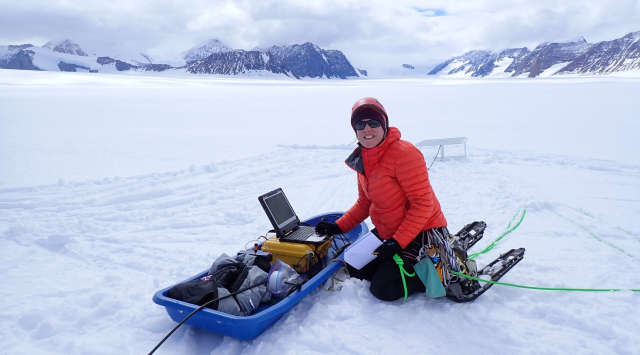
From Scotland to Antartica
When Kate was younger she really questioned why things looked the way they did – for example, why there are hills, and sand dunes, and why rivers have bends in them.
Taking Geography and Geology at secondary school helped her find some of the answers to her questions. When she was told that ice could flow like a river she wanted to never stop learning about ice!
Travelling to Antarctica is definitely the most amazing part of my job, but I also like to be creative, making drawings so that other people can understand the work I do.
Kate also studied Art and French at school. Her art skills help her to communicate science, and her language skills help her to work with international teams.
After school Kate studied for a Geography and Geology degree at Aberdeen University. Then she studied for a Masters in Polar and Alpine Change at the University of Sheffield, and finally Kate completed a PhD at Northumbria University.
Kate’s STEM attributes
Kate is collaborative because she has to work in teams in Antarctic to set up monitoring equipment and collecting rock samples. She is creative because she has to present her scientific findings to others.
I like to make and draw diagrams that help to explain my work.
Kate is curious because she questions how ice flows in Antarctica and has to consider how it may change in the future, as the world warms.
Antarctica is a remote, difficult place to work. It is often very cold and windy so Kate needs to be hard-working to take measurements when the weather is good.
Kate needs to be organised. There are no shops in Antarctica so she has to carefully consider what experiments she needs to conduct in Antarctica and what equipment she needs to take with her on the plane.
If I forget something as simple as a screw or a cable, my experiment may not work.
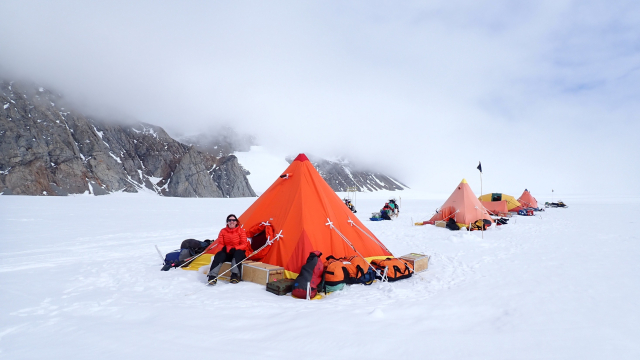
Creative Kate
Kate is creative in her time outside work too. She likes to learn new art skills, like pottery or crochet. Using her time in Antarctica as inspiration, Kate made an embroidery showing Antarctica and the currents in the Southern Ocean. These currents transport nutrients around the continent. The red cross shows the location of the Princess Elisabeth Antarctica Research Station, where Kate does most of her research.

Kate also likes to spend time outside, walking or cycling.
Kate wrote an article about her time in Antarctica which you can read online – Iron woman: searching for iron at the end of the earth.
Kate’s advice to young people is:
Sometimes it’s hard to know what you want to do when you grow up, but sometimes, it’s nice to think about the kind of place you’d like to work. Maybe in an office, at your home, or outside – in a hot place or a cold place. That might help you to find a job in an environment that suits you. Good luck!
You can go to Antarctica without studying for a PhD though. Have a look at jobs available on the British Antarctic Survey website. They need lots of people to run Antarctic research stations and support science activities – like builders, plumbers, chefs and pilots.

Kate’s adventures in Antarctica
Take a look at the photographs and messages Kate sent to NUSTEM on our Kate in Antarctica pages.

 yes
