Case Study: Kirsty Lyndsay
Position: Assistant Professor of Physiotherapy at Northumbria University
Key Attributes: imaginative, curious, committed
Qualifications: Apprenticeship, Degree, Masters, PhD
“I like finding out new things no one else knows yet, and I love looking up at the stars and knowing I’m helping humans explore the universe.”
At a glance
Kirsty is a physiotherapist and researcher who helps people recover from injuries using exercise. She also studies how astronauts can stay healthy in space. She is imaginative and designs experiments and creates exercise equipment to test new ideas. Kirsty is curious and studies how astronauts’ bodies change in space to find better ways to help people on Earth. She is committed and balances three different parts of her job: research, treating patients in her clinic and training new physiotherapists.
A happy accident
Kirsty’s path into her current career far from straightforward.
“It was an accident! I loved space as a child, but it wasn’t a career path available for girls from England in the 1990s. I was an apprentice aircraft engineering technician first, got injured and then re-trained as a physiotherapist.”
As a physiotherapist, she learned how to help people recover from injuries and illnesses using exercise and treatment.
A few years later, Kirsty was finding her clinical job wasn’t challenging her enough, so she decided to do a Masters degree in Space Physiology and Health. This combined her childhood love of space with her skills as a physiotherapist.
At the end of her Masters degree, Kirsty got a job as a Young Graduate Trainee at the European Space Agency working as a project scientist. She then started a PhD at Northumbria University, where she now works as a staff member.
Three jobs in one
Today, Kirsty’s job has three main parts: physiotherapy, teaching and research. Being committed is essential because she needs to balance all three roles.
When doing research, Kirsty collects data about how to make exercises more effective for rehabilitation. This means finding better ways to help people recover from injuries.
When doing physio, she runs an outpatient clinic where she treats injuries and illness, mostly with exercise. She helps people get back to doing the things they love.
When teaching, Kirsty trains new physiotherapists how to do their job at university. She needs to explain complex ideas clearly to students and make sure her patients understand their treatments.
“My job has 3 main elements: physiotherapy, teaching and research.”
Floating in weightlessness
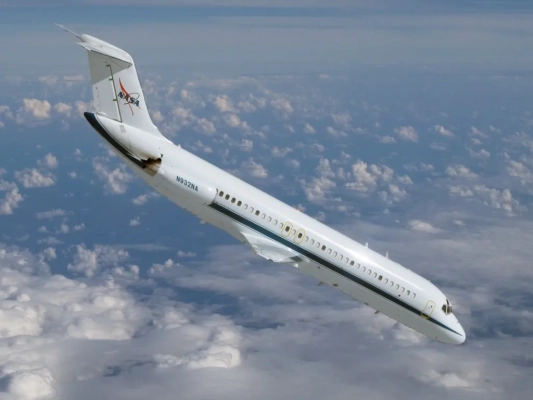
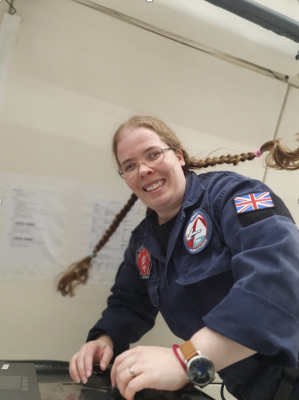
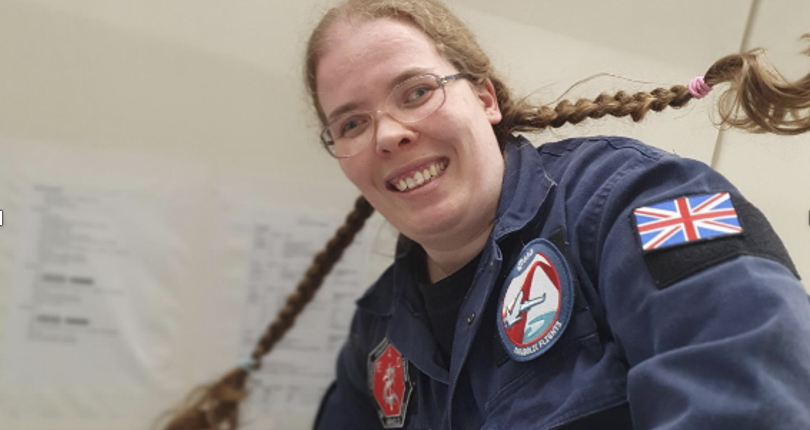
The coolest thing Kirsty has done is go on a parabolic flight where she got to float in weightlessness! A parabolic flight is when an aircraft flies in a curved climb-and-descend pattern that creates brief periods of weightlessness, just like astronauts experience in space.
She’s also done research in bed rest studies, where people stay in bed for a whole sixty days pretending to be in space. This helps scientists understand what happens to the body when astronauts spend long periods in space without gravity.
Kirsty is an aerospace physiologist and physiotherapist, which means she studies how our bodies work… and fixes them too!
Designing new solutions
Kirsty is imaginative in how she approaches her work. She designs experiments to test new ideas and creates new exercise equipment to help people recover from injuries more effectively.
“I design experiments to test new ideas and I design things to make exercise more efficient, like a new exercise device!”
One example is a suspension system she helped design to simulate being in space in the lab. This allows researchers to study how the body behaves in conditions similar to weightlessness without actually going to space.
She also tests exercise devices in her lab next to the Physio Clinic, always looking for better ways to help people recover.
A love of space

Kirsty is passionate about space. Looking up at the stars and knowing she’s helping humans explore the universe is one of the most rewarding parts of her job. She loves finding out new things that no one else knows yet.
“I love space and it makes me happy to talk about it.”
Outside work, Kirsty does lots of different fibrecrafts like crochet, weaving and spinning yarn. She also likes swimming, watching her daughter play football, and reading.
Her advice to young people is clear and encouraging:
“Always go after your dream: hard isn’t the same as impossible, so go for it. You won’t always succeed but at least try.”
Kirsty’s journey shows that careers can take unexpected turns. What started as an injury during an apprenticeship led her to physiotherapy, which eventually brought her back to her childhood dream of working with space exploration. Starting as an apprentice aircraft engineering technician and building through continuous learning, she’s now helping astronauts stay healthy and training the next generation of physiotherapists.