Sixth Form Evening Lectures

How Physical Sciences and Mathematics Make a Difference in the World

Aim and audiences

The NUSTEM Evening Lectures are aimed at Y11 to Y13 students and their teachers. Each lecture is focused on a different topic, and aims to show how Physical Sciences and Mathematics matter and where they can lead. The lectures are mainly presented by Northumbria University researchers, with some guest speakers from industry.

The lectures will run every Thursday from 17:30 to 18:30 starting on the 6th November 2025.

Attendance is free, and preferably in person.

Next steps

STEP 1 – Explore our programme below. It contains a summary of all lectures available to attend.

STEP 2 – Book a place in your favourite lectures by clicking the “click to show booking form” under the book your place button. This will reveal a easy form to fill in. We are collecting information mainly to make sure we have a big enough room to seat everyone.

STEP 3 – Come along on the day and time of the lecture! More information in how to find us is at the bottom of this page. We will have some refreshments and snacks waiting for you.

STEP 4 – If you cannot join us in person (and we strongly recommend you do!) just press the join lecture here button. This will take you to a Teams town hall meeting for you to join in.

On this page

Y11-Y13

Thursdays 17:30-18:30

Address Address icon

Northumbria University

(except 11th December – see notes for details)

2025 Evening Lectures Programme

06 NOV

Lecture 1 – The James Webb Space Telescope: New Eyes on the Universe

The JWST is the most advanced telescope ever constructed, and it was launched into space on Christmas Day 2021. Since then, it has provided a completely new view of our universe, beaming back incredible images of everything from the planets in our own Solar System to the most distant galaxies ever observed.

Come along to learn about some of the greatest discoveries, and how astronomers at Northumbria University are using this extraordinary telescope.

Book your place

Please register for in-person or online attendance.

Join lecture online Join lecture online

Join lecture online

Active from 17:15 on 6th November.

Presenter

13 NOV

Lecture 2 – Can Solar Panels Really Outshine Climate Change?

Climate change is one of the greatest challenges we face and the race to achieve net-zero is becoming ever more intense. Fossil fuels remain the main driver of climate change and to tackle this we are increasing the amount of renewable energy we use. Solar panels are expected to be at the core of this renewable energy transition due to them being a clean, low-cost and reliable alternative – but are they really as green as they seem?

In this talk, we will explore solar power from a Life Cycle Assessment perspective – a way of measuring environmental impact from manufacturing to disposal. By looking at the bigger picture of solar technology and its side-effects on the environment, we will find out if solar panels really can outshine climate change.

Book your place

Please register for in-person or online attendance.

Presenter

Bethany Willis

20 NOV

Lecture 3 – Invisible Currents: How We Protect Ourselves from Hidden Waves

Have you ever wondered why your phone sometimes loses signal, or how astronauts are protected from space radiation? What if I told you we live in a world filled with invisible waves—buzzing all around us from phones, Wi-Fi, microwaves, and even lightning!

In this fun and interactive talk, we’ll explore the mysterious world of electromagnetic waves—what they are, where they come from, and how they affect our lives. But don’t worry—we’re not here to scare you. We’re here to show you the cool science behind how engineers build invisible shields to block or control these waves.

We’ll play with real-life examples like phone cases, airplane windows, and even superhero suits (yes, really!). You’ll also find out how this research helps protect hospitals, airplanes, space missions—and maybe even your brain from too much screen time!

Get ready to uncover the secrets of electromagnetic shielding and see how science is quietly guarding your world—every second of every day.

Book your place

Please register for in-person or online attendance.

Presenter

Aqsa Arshad

27 NOV

Lecture 4 – The complex beauty of fractal geometry

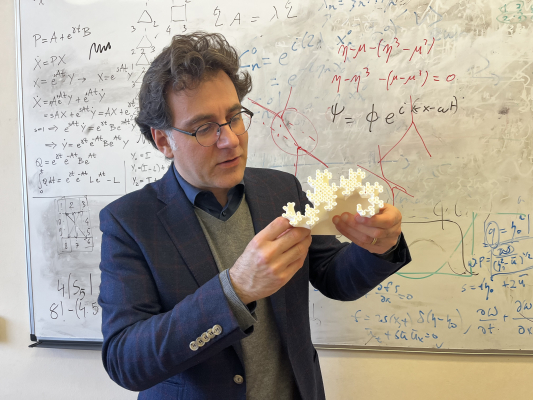
In this lecture, Matteo will explain – with the aid of some computer graphics – how fractals can be defined as geometrical objects characterised by two properties: self-similarity, and non-integer dimension. Differently from the ‘smooth’ figures of classical Geometry, such as circles or triangles, fractals turn out to be ‘rough’ and infinitely complex.

Book your place

Please register for in-person or online attendance.

Presenter

04 DEC

Lecture 5 – On thin ice: how do scientists investigate melting glaciers?

How fast are sea levels rising? What causes an ice age to start or end? How do glaciers affect the weather? In this lecture, we will dive into the fascinating world of snow and ice. We will look at how scientists research climate change and try to find an answer to questions such as these.

Book your place

Please register for in-person or online attendance.

Presenter

Max Brils

11 DEC

Lecture 6 – Comets

Our solar system is a treasure trove of objects, but the most interesting may be the comet. While it is smaller than the average city, it can leave trails and tails that span from one planet to the next, all because it is made of dust and ice. Within this lecture we will explore comets using cutting edge measurements made by spacecraft and link their findings to the origin of life itself. We will look into the future of space exploration and even outside of our own solar system.

Location!
Map Map

This lecture will take place in-person at the Blyth Energy Central Campus Learning Hub, and will also be streamed online.

Book your place

Please register for in-person or online attendance.

Presenter

Charlotte Goetz

How to find us and joining lectures online

How to find us

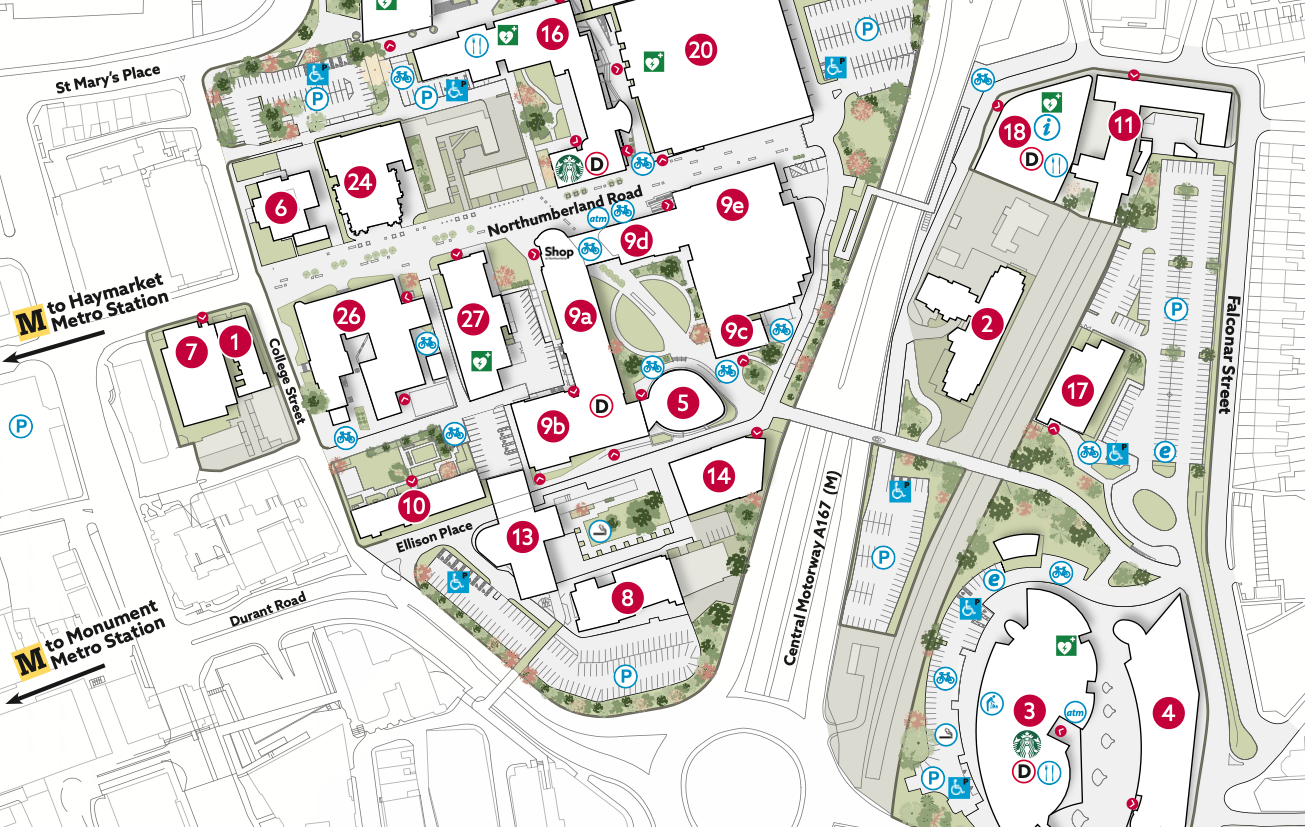
The evening lectures will take place in Ellison Building A-block, room ELA 009.

The Ellison Building A-block is the building number 10a on the map below:

You want to enter the building using the automatic revolving doors located in Northumberland Road as seen in the photo below:
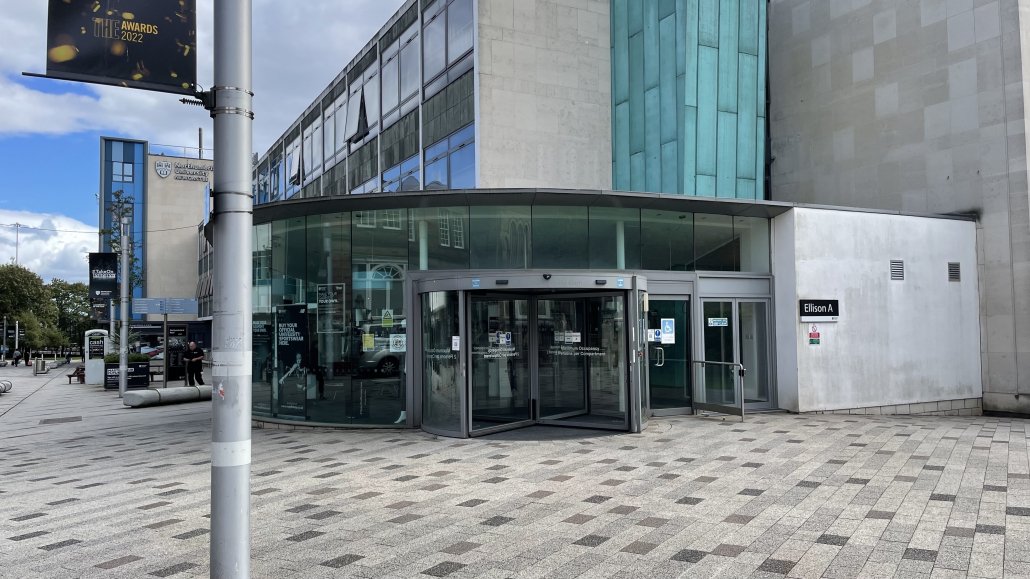
The entrance can be found with:

  • Postcode NE1 8SG
  • What 3 words: ///scouts.shower.exit

Alternatively you can use the entrance (set of automatic double doors) located on Ellison Place:

  • Postcode NE1 8ST.
  • What 3 words: ///moth.under.golf

Here is a short video showing the location of the room ELA 009:

Joining online

We encourage you to attend the evening lectures in person.

We understand, however, that this is not always possible, so we will be live-streaming the lectures using the Town Hall feature in Microsoft Teams. You don’t need to have Microsoft Teams installed on your device.

After booking a place for the evening lecture just press the Join online button next to each evening lecture description.

The button will open a webpage which you lets you choose to watch the either in your web browser, or join via the Teams app.

We recommend you join the lecture using a laptop/desktop  computer rather than a mobile device.

Throughout the lecture you will be able to ask anonymous questions to our presenters using a moderated Q&A.

Click here to find out more about how to join and participate in a  Town Hall meeting.

2024

07 Nov – Why does space sing? (And why should I care?) by Daniel Ratliff

14 Nov – Should I worry about space weather? by Clare Watt

21 Nov – How can we store energy, and why is it important? by Yolanda Sanchez

28 Nov – How much, how fast? Predicting ice sheet melt by Jo Zanker

05 Dec – The James Webb Space Telescope: New Eyes on the Universe by Henrik Melin

12 Dec – The complex beauty of fractal geometry by Matteo Sommacal

2023

  • 09 Nov – Nature’s Blueprint: the physics of bio-inspired surfaces by Prashant Agrawal
  • 16 Nov – Talking in Light: Satellite Laser Communication by Mansour Abadi
  • 23 Nov – Heating with light: a possible way to new solar cell design by Giulia Longo
  • 30 Nov – Why does space sing? And Why should I care? by Daniel Ratliff
  • 30 Nov- When plants eat animals: what physics and chemistry can we learn? By Ciro Semprebon
  • 07 Dec – Snowflakes in the Oven: Coronal Rain in the solar Corona by Patrick Antolin
  • 07 Dec – An introduction to quantum Chaos by Remi Dubertrand
  • 14 Dec – Complex beauty of fractal geometry by Matteo Sommacal

2022

  • 02 NOV – Moulding the flow of light by Daniel Ho & Mike Taverne
  • 09 NOV – Electrical currents in space by John Coxon
  • 16 NOV – Make food waste, wood waste by Madeleine Combrick
  • 23 NOV – Mathematical fractals by Matteo Sommacal
  • 30 NOV – the Cahotic Quantum world by Remy Dubertrand
  • 07 DEC – From lasers to Masers by Juna Sathian
  • 14 DEC – Tackling climate change with solar photovoltaics by Neil Beattie

2021

  • 09 DEC – Magnetic fields in the Universe by Stephane Regnier
  • 02 DEC – Complex & intelligent systems by Ben Huard
  • 25 NOV – Mathematical fractals by Mattteo Sommacal
  • 18 NOV – Solar cells and light emission by Giulia Longo
  • 11 NOV – Engineering solutions from waste by Madeleine Combrink
  • 04 NOV – the Chaotic Quantum World by Remy Durbertrand
  • 21 OCT – Engineering porous materials by Dominica Zabiegaj
  • 14 OCT – Space Weather by Clare Watt
© Northumbria University 2014-26