Download progression document
Includes statements from Development Matters (birth to age five) and the relevant ELGs in full, for the Weather forecast provocation

Includes statements from Development Matters (birth to age five) and the relevant ELGs in full, for the Weather forecast provocation
Play, Be, C Units provide enabling environments with teaching and support from adults. Reflecting on the characteristics of effective teaching and learning, children will have opportunity to learn and develop by:
- Playing and exploring – children investigate and experience things, and ‘have a go’.
- Active learning – children concentrate and keep on trying if they encounter difficulties and enjoy achievements.
- Creating and thinking critically – children have and develop their own ideas, make links between ideas, and develop strategies for doing things.
Early Years Foundation Stage Statutory Framework: accessed November 2024. Available under the Open Government Licence v3.0.
10 minutes or so
Meteorologist, weather, rain, sun, wind, fog, ice, snow, thunder, lightning, hail, hot, cold, freezing, clothes, material, waterproof, warm, cool, record, play, forecast.
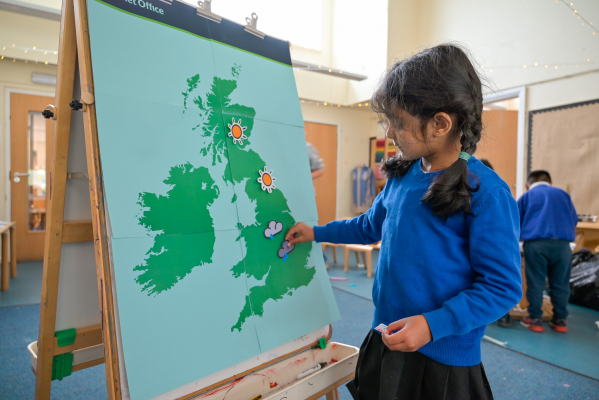
Prepare your weather forecast “studio” by attaching your map to a wall or stand and getting your weather symbols along with the clothing for different weather condition together.
Tell the children that some people who present the weather forecast on the television are meteorologists. You could show them the meteorologist poster. Watch an example weather forecast with the children. They are curious about what the weather will be like tomorrow and for the rest of the week. They are going to observe the weather and choose the best clothes to wear.
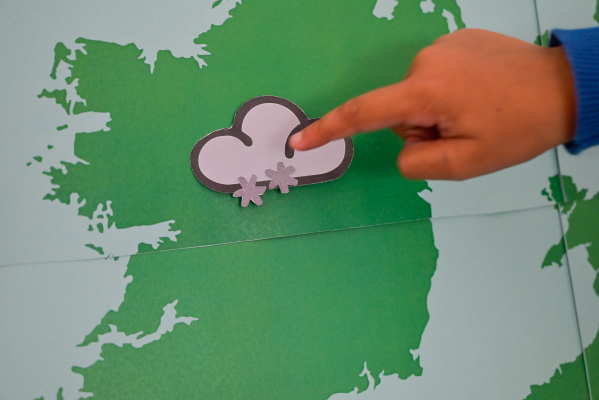
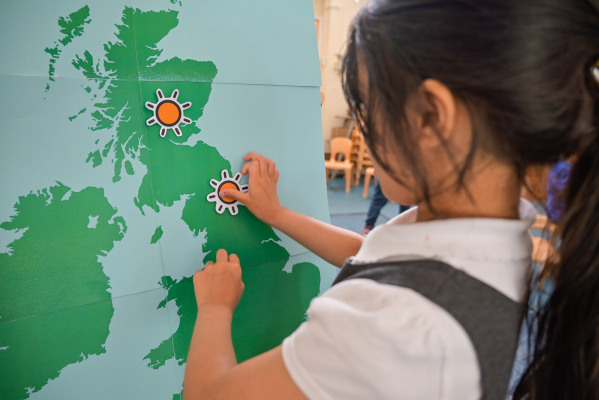
Challenge the children to present the weather by sticking the weather symbols to the map.
Encourage the children to select and wear the appropriate clothes for the weather.
Record the children presenting the weather and encourage them to record each other.
Remember to refer to the children as Meteorologists and praise them for using the attributes. You could say things like:
“Well done, you observed the weather and chose the best clothes to wear…”
We have put together some useful information about the science of meteorology to accompany this activity. Don’t worry, this is for your information only and to help you answer any questions children may have. We don’t expect you to explain this to the children in your setting!
Weather is how the atmosphere is behaving at any time and includes the temperature, precipitation, air pressure and cloud cover. Daily weather changes are due to winds and storms but seasonal weather changes are due to the earth orbiting the sun.
The sun shines more directly on the equator, so surface temperatures are warmer here. The polar regions get the least light from the sun, so temperatures are coolest here. Air rises at the equator and travels north or south towards the poles where it cools and falls. Air moves from places of high-pressure (where there’s a lot of it) to places of low-pressure (where there is less of it). This causes a restless movement of air and water vapour in swirling currents to distribute the heat energy from the sun across the planet.
Meteorologists use measurements of what the weather is doing now, calculate how this might change in the future, and use their knowledge to improve their predictions.
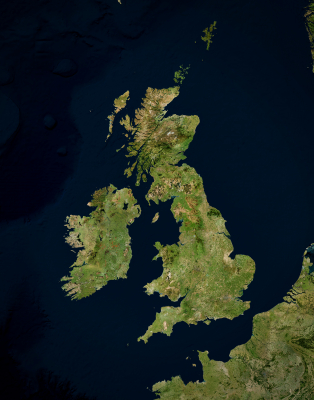
They observe and record the weather 24 hours a day across the globe. They can combine this with satellite pictures to see how the Earth’s atmosphere is behaving in terms of temperature, rain or snow fall (precipitation), air pressure and cloud cover.
Meteorologists use thermometers to measure temperature, barometers to measure air pressure, and anemometers for measuring wind speed. They use weather balloons to measure temperature, air pressure, wind speed and wind direction in the lower levels of the Earth’s atmosphere and where almost all weather conditions take place.
Meteorologists input the weather data collected into a supercomputer that performs complex equations to create models that predict the future weather. They check their models to make sure their forecasts are going to plan and adjust them where necessary.


 Sun catcher provocation