Download progression document
Includes statements from Development Matters (birth to age five) and the relevant ELGs in full, for the Light box provocation

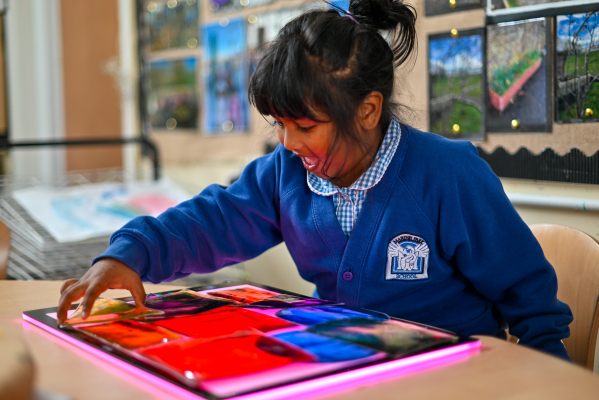
Includes statements from Development Matters (birth to age five) and the relevant ELGs in full, for the Light box provocation
Play, Be, C Units provide enabling environments with teaching and support from adults. Reflecting on the characteristics of effective teaching and learning, children will have opportunity to learn and develop by:
- Playing and exploring – children investigate and experience things, and ‘have a go’.
- Active learning – children concentrate and keep on trying if they encounter difficulties and enjoy achievements.
- Creating and thinking critically – children have and develop their own ideas, make links between ideas, and develop strategies for doing things.
Early Years Foundation Stage Statutory Framework: accessed November 2024. Available under the Open Government Licence v3.0.
Light, dark, shadow, source, block, change, shape, travel, long, short, big, small, straight, solid (opaque), see-through (transparent), translucent (you can see light through it but not clear shapes) colours- bright, dim, fuzzy, clear
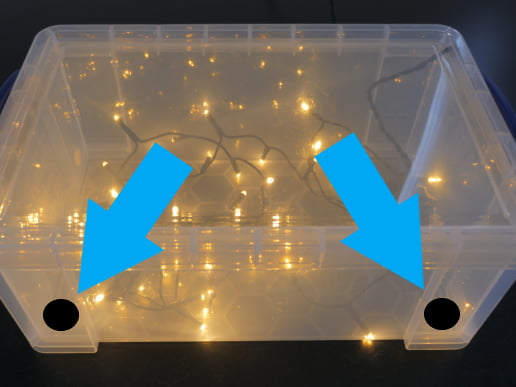
If your fairy lights use mains power, drill a hole in the box near the bottom and a corner. You will need it to be big enough to slide your lights through into the box, while the plug remains outside the box.
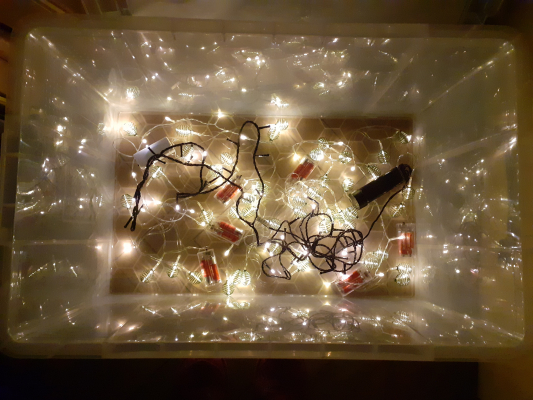
Spread out the lights at the bottom of the box. the more sets of lights you can use, the more effective the light box. Turn the lights on.
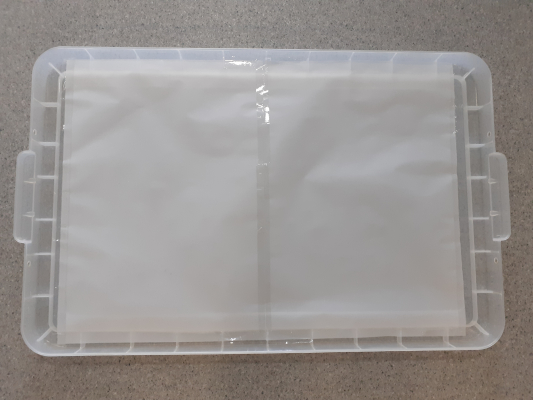
If you can see the shape of the lights clearly through the lid, you need to line your lid with tracing paper or grease proof paper to make it translucent (the light shines through but you can’t see a clear shape). Put the lid back on and you are ready to go.
Show the children the lighting technician poster. Tell the children that lighting technicians are creative and you want them to observe and investigate the different patterns, shapes and colours they can create on the light box with the different materials and objects.
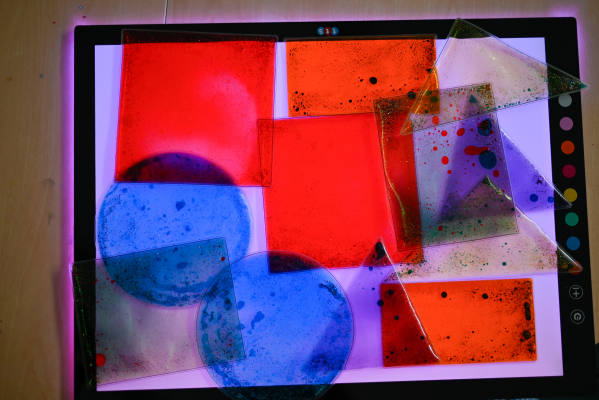
Remember to refer to the children as lighting technicians and praise them for using the attributes. You could say things like:
“You have been observant like a lighting technician and noticed what happened when you put that material on the light box…”
“Well done, you have been really creative in the way you used those materials to change the way the light looks …”
We have put together some useful information about the science of lighting technicians to accompany this activity. Don’t worry, this is for your information only and to help you answer any questions children may have. We don’t expect you to explain this to the children in your setting!
The light we see is made up of the different colours of the spectrum, these are the colours of the rainbow. Before Isaac Newton (1643 – 1727) when people talked about the rainbow they only included 5 colours – there was no orange or indigo. Newton added in two extra colours because he thought that 7 was a perfect number!
Some of the materials you used are transparent – we could see through them and they let all of the light through them. Examples are clear plastic, cellophane, water and glass.
Some of the materials you used are translucent. This is when material absorbs part of the light but allows part of the light through. The light that travels through the material is scattered so that you cannot see clearly through the material. Examples are tissue paper and frosted glass.
For both transparent and translucent materials, if your material looked green, it only let green light through and absorbed all the other coloured light. If your material was red, it only let red light through and so on.
Some of the materials you used were opaque – they absorbed all the light. Examples are wood, thick plastic and metal.

Some of the materials absorb less of the light and let more of the light through. This makes the light look like it is shining more brightly through those materials.


 Shadow puppets provocation