Download progression document
Includes statements from Development Matters (birth to age five) and the relevant ELGs in full, for the Lava lamps adult led activity

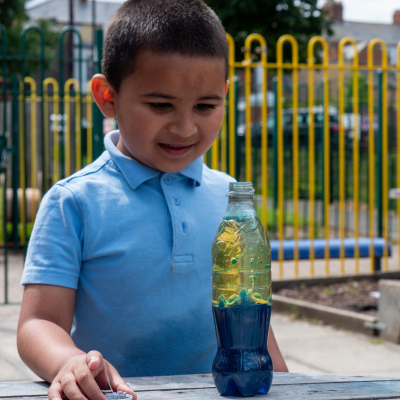
Includes statements from Development Matters (birth to age five) and the relevant ELGs in full, for the Lava lamps adult led activity
Play, Be, C Units provide enabling environments with teaching and support from adults. Reflecting on the characteristics of effective teaching and learning, children will have opportunity to learn and develop by:
- Playing and exploring – children investigate and experience things, and ‘have a go’.
- Active learning – children concentrate and keep on trying if they encounter difficulties and enjoy achievements.
- Creating and thinking critically – children have and develop their own ideas, make links between ideas, and develop strategies for doing things.
Early Years Foundation Stage Statutory Framework: accessed November 2024. Available under the Open Government Licence v3.0.
Liquid, mixture, solution, gas, air, blow, wind, move, rise, float, sink, up, down, across, left, right, big, huge, large, enormous, round, sphere, burst, surface, inside
Before starting this activity, please make sure that the children in your setting understand:
Show the children the fluid scientist poster and tell the children that they are going to be fluid scientists for this activity.
Ask the children if they know what a fluid scientist does. Fluid scientists are interested in what liquids, and gases are like and how they move and behave. Liquids and gases are examples of fluids
Tell the children about the attributes. Fluid scientists are:
Curious – about what different fluids can do and how they might help us.
Observant – they watch fluids carefully to see how they behave.
Resilient – they try lots of tests before they find the best uses for different fluids.
Tell the children that they are going to be curious about creating bubbles without blowing. They will be observing what happens to the fluids in the bottle.
Fill one third of the bottle with water and add food colouring. You could get the children to do this. Fill the other two thirds of the bottle with oil. You may want to do this!
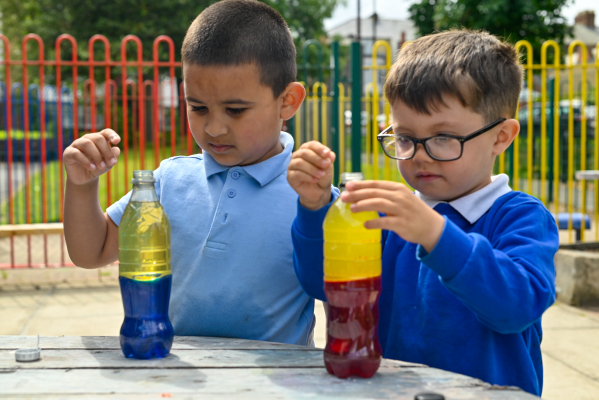
Give each child an effervescent vitamin C tablet. Ask them to break it in half and drop it in the bottle. Don’t put the lid on or the gas will build up in the bottle.
You can either drop in the other half to make more bubbles or wait until the bubbles stop before adding the second half of the tablet.
When the bubbles have stopped, you can use the same bottle of oil and water with other groups of children.
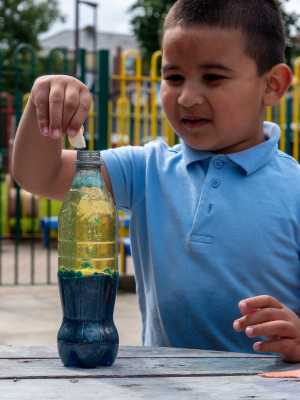
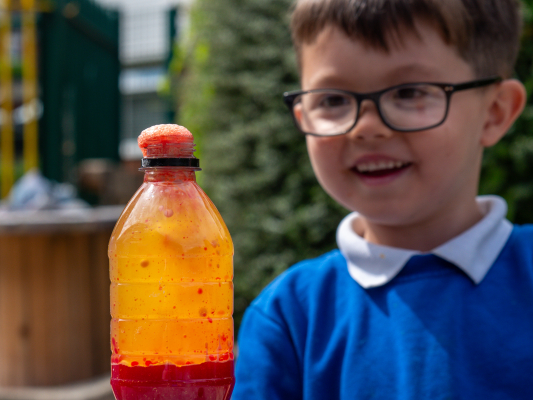
Remember to refer to the children as fluid scientists and praise them for using the attributes. You could say things like:
“You have been observant like a fluid scientist by watching what happens to the bubbles…”
 have 10 more investigations you can do with baking powder or bicarbonate of soda.
We have put together some useful information about the science of fluids to accompany this activity. Don’t worry, this is for your information only and to help you answer any questions children may have. We don’t expect you to explain this to the children in your setting!
Effervescent means giving off bubbles or fizzy. Effervescent tablets contain sodium bicarbonate and citric acid. When added to water, they react to form a salt and bubbles of colourless carbon dioxide gas.
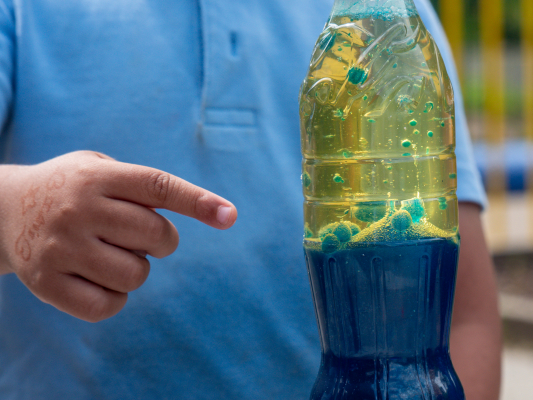
Density describes how much space an object or substance takes up (its volume) in relation to the amount of matter in that object or substance (its mass). More dense liquids, such as sugar solution or honey, will sink below less dense liquids, like water. Oil is less dense than water, so will float to the top. We used the oil in this investigation so that we can see the bubbles travelling upwards clearly.
The bubbles in this investigation are carbon dioxide gas, which has a lower density than water. If the molecules of an object are very tightly packed, it has a high density. If molecules have more room to move around, the object has a lower density. As the bubbles are less dense than the liquid around them and they rise to the surface. This upward force is called buoyancy.
Just like bubbles of carbon dioxide in fizzy drinks, when the carbon dioxide bubbles in the lava lamps reach the surface they are released into the air.
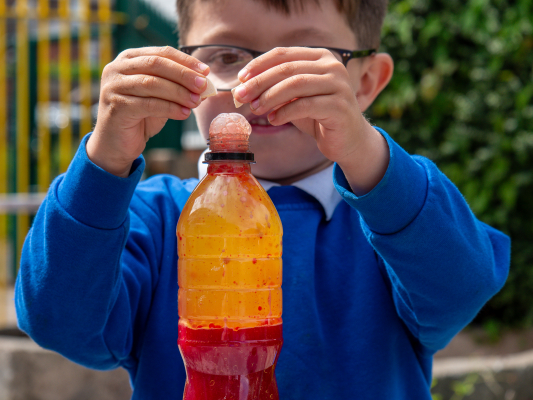
The liquid at the bottom of the bottle is coloured water. This is more dense than the oil so sinks to the bottom of the bottle. The vitamin C tablet also sinks to the bottom of the bottle, where the ingredients react in the water to produce carbon dioxide bubbles. The bubbles are dyed water, surrounding carbon dioxide. The dyed water gets dragged up through the oil by the gas.


 Bubble wands provocation