Arborist family STEM story time
Challenge families to find as many different parts of trees as they can lying on the ground in your outside area.

Children’s parents, carers and other family members all help shape children’s ideas about themselves and what they should do with their lives, including what would be a suitable future job for them.
A family STEM story time is an opportunity to introduce STEM ideas and activities in a relaxed and enjoyable way. STEM story time also provides an opportunity to positively model how adults and children can share stories together.
Each session begins with a high quality STEM story which introduces a STEM concept or problem to the group. The session then continues with a practical activity based on the concept introduced by the story. This is designed to be completed by an adult and a child working together. They can successfully complete the challenge together, ensuring their experience of STEM is a positive one.
For this activity, you’ll invite children’s parents or carers into your setting, so they can work alongside each other.
This is an outdoor activity so family members will need to dress for the weather.
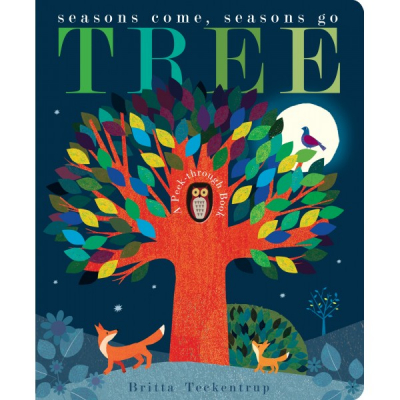
Seasons Come, Seasons Go, Tree is widely available from bookshops and education suppliers.
Bark – the outer layer of a tree.
Flower – the coloured part of a plant from which the seed or fruit develops.
Fruit – a sweet and fleshy product that can be eaten as food and contains seeds.
Seed – a small, hard part of a plant from which new plants can grow, also known as kernel, pip, pit or stone.
Nut – a seed contained in a hard shell which doesn’t naturally open to release the seed.
Do these things before the session
The easiest and most effective way to make the collection cards is to prepare them using double sided tape, but if you prefer, you could give families a card and a roll of clear sticky tape or glue dots to attach their natural materials to the card.
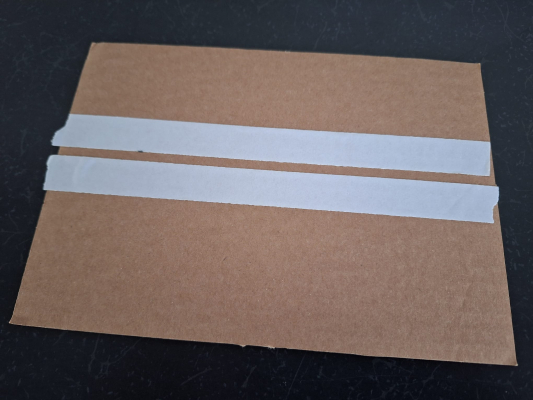
If you are using boxes, cut the card to the size you want- between A4 and A5 works well. Stick a strip of double sided tape (or several strips if you are using a thin roll) down the centre of the card. Don’t peel the backing off yet- the families will do this at the story time.
We have found that there is usual a couple of families who rip the card instead of peeling off the backing, so it is a good idea to make a few extra cards.
You might want to identify the things you can find in the outdoor area you are using before the activity. The Woodland Trust have some great identification sheets you could use.
For this activity you will need to be outside in an area that has trees that have plenty of fallen leaves, twigs, seeds, nuts or bark beneath them.
If you don’t have trees in your grounds, you could:
Think about:
If you have already had story times with your families you will know what works best in your setting, but if not you may want to consider:
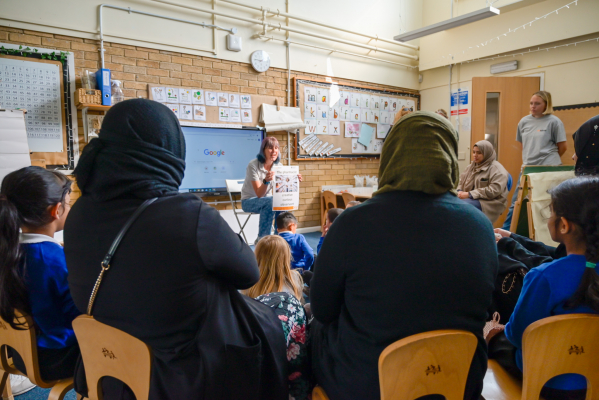
Start the session by showing families the arborist poster and telling them that an arborist is a job that uses science. If you have already done some of the activities from the arborist unit, you could ask the children to explain to their families what a arborist does. If this is a new topic, you could ask the families if they have any trees growing in their gardens, on their street or near to the setting. You could ask the families who they think look after the trees to make sure they are safe and healthy.
Tell everyone that for this activity, they are going to be like arborists.
You could tell the families that arborists work for lots of different people to make sure their trees are healthy. Arborists are sometimes called tree surgeons. An arborist doesn’t just use a chainsaw to cut down trees, they also look after them and grow them. Typical work for an arborist includes pest control, tree moving, stump removal and looking after the soil and trees in general.
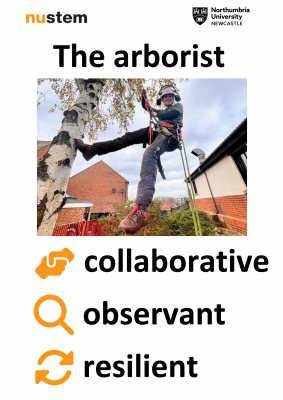
Introduce the attributes by telling the families that attributes are personal skills or qualities that we already have, and that are needed to work in a STEM career. You could tell them that arborists are:
Collaborative when they meet with people to plan how to look after their trees. They work in teams so they can keep each other safe.
Observant and notice what they need to do keep trees healthy, or if there are branches that need to be removed or cut down.
Resilient as their job is very tiring: climbing trees, digging out stumps and clearing away branches.
During the activity, the children and adults might also be able to identify where they are using these attributes.
You know the families in your setting and the best way to read a story to them, but to help we have designed these STEM focused questions to use alongside the questioning you would usually use when reading a story.
After reading the story, please make sure that the children understand that they should never put berries or any other items they find on the ground or growing on trees or bushes in their mouths.
Show the arborist poster again and use the attributes in the activity explanation. You could tell the families that they are going to be:
Collaborative like arborists as they will be working together as a family to collect items that have fallen from trees,
Observant like an arborist as they need to spot items that have fallen from the trees on the ground and look carefully to make sure they have collected lots of different things,
Resilient like an arborist as we need to go outside no matter what the weather!
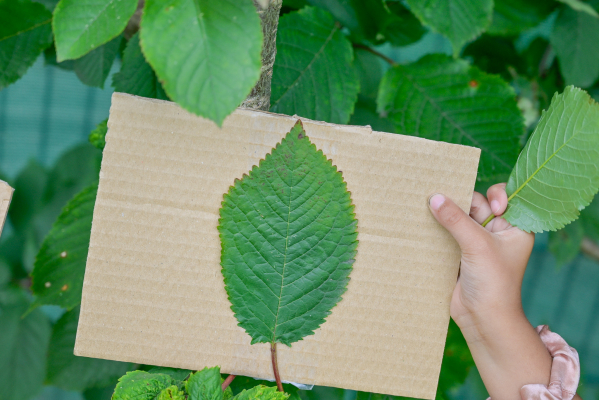
Families are going to look around the outside area and find as many different items that have fallen from trees as they can and stick them onto the tape on their cards.
You know your families best, but you may want to explain why you don’t want them to pick things that are growing and about their responsibilities in keeping their children safe. You may want to remind the children that they are going outside to be arborists and have this task that they need to complete.
Show the families how to peel the backing from the tape to reveal the sticky surface. If it is raining or windy, you may want to give the families a plastic bag to keep their card in while they are working outside.
While the families are collecting, you could help them identify what they have found. You might want to provide the families with the appropriate Woodland Trust identification sheets or use these as an extra challenge for families.
You may want to set a time limit for collection and tell the families that you will provide your usual signal (clapping, tambourine, bell etc) that it is time to come back together again.
Remind children not to put any of the things they have collected in their mouths.
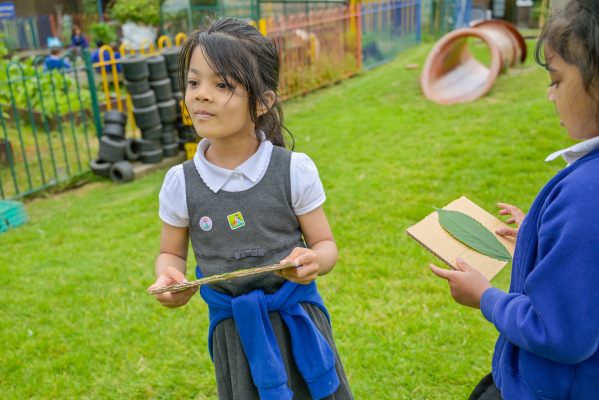
When you have brought the families back to together, you may want to discuss what each family has found. Ways to do this could include:
You might want to provide the families with the appropriate Woodland Trust tick sheets to help them identify what they have found.
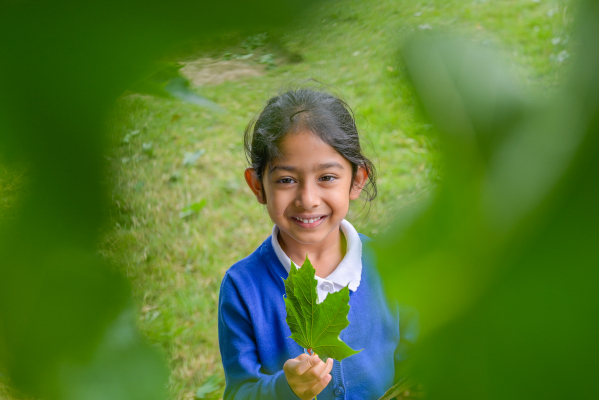
When you have finished discussing the collections made, you could remind them of the attributes they have used: being collaborative when they worked together as a family to collect items that had fallen from trees, observant when they looked carefully to make sure all their items were different and resilient like an arborist as they went outside no matter what the weather!
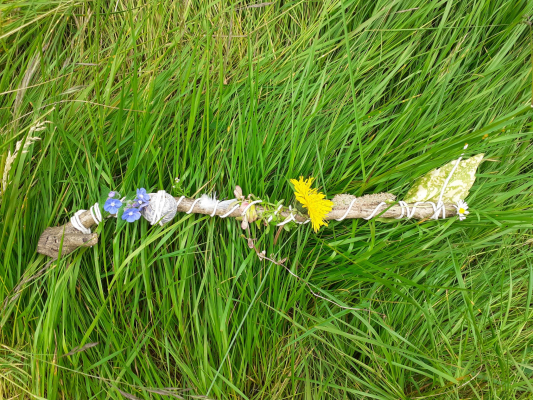
There is a STEM at home activity linked to this activity. This includes a similar journey stick activity, more STEM careers information and other activities for the whole family to try at home.
You could tell the families that if they have enjoyed today’s activity, maybe they could be arborists in the future.
This section is for your information. It’s intended to be useful background – you’re welcome to include it in the session, but we expect you’d more commonly draw on it when children or their families have questions.
Trees that change over the year are called deciduous trees. This is because deciduous means “to fall” and the leaves of these trees fall off in the autumn. In the spring the buds start to appear and they produce blossom. By the summer the trees are full of leaves. The leaves are green because they contain a chemical called chlorophyll which helps them to photosynthesise.
Once the blossom has been pollinated and fertilised, the trees produce their seeds and fruit. This is generally in late summer or early autumn. During the autumn, days become darker and the trees can’t make as much food. The leaves lose their green chlorophyll and we see them turning yellow, orange or red before falling off the trees.
During the winter, trees become dormant (stop growing) and protect themselves from the cold weather by producing hormones to combat dehydration and frozen cells.
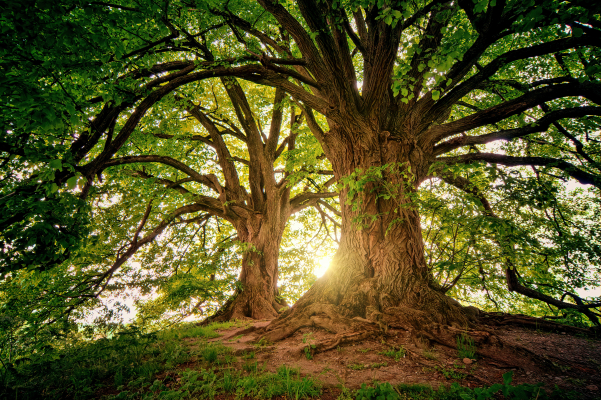
Photosynthesis is the name for the process by which a plant uses water and carbon dioxide to make glucose (a type of sugar) and oxygen. It is a chemical reaction which takes place in the special structures in the leaves called chloroplasts. The green colour is due to the presence of chlorophyll, which is the chemical used in photosynthesis, and which has a green colour.
Sunlight provides the energy for photosynthesis to happen, which means that trees can only make glucose during the day.
Trees use the glucose to produce energy, or make more complex carbohydrates. These can be stored by the tree, or formed into the materials in the leaves, trunk and other parts of the tree.
Evergreen trees have green leaves all year, which they shed continuously as new leaves grow. Evergreen trees grow slowly, photosynthesising all year round.
The leaves of evergreen trees have a thick waxy coating of resin to protect them. This prevents the water inside the leaves from freezing and damaging them in the winter. Many evergreens also have needle-shaped leaves, to conserve water, but the leaves can be a variety of shapes and sizes. Conifers, hollies and rhododendrons are examples of evergreen trees.
Deciduous trees lose their leaves during the winter because otherwise the water inside the leaves would freeze and expand, rupturing the leaves and causing damage to the tree.
In general, larger leaves mean that trees can carry out more photosynthesis and make more glucose, so bigger leaves are better. However, leaf shape is also determined by factors such as overheating, freezing, getting water to the leaf cells, and wind resistance.
Leaves can grow large if they have enough water and do not overheat. However, larger leaves lose more water from the plant and cool down more quickly. This is why tropical plant leaves can grow to be huge in places that are warm and wet, and small-leaved plants thrive in dry deserts and high up mountains. Small leaves, like pine needles, which are packed together tightly can stay warmer so survive in colder climates, whereas leaves with lobes can help plants to cool down more easily.
Getting water to leaf cells is easier if a leaf is long and thin, or has a simple branched shape matching vein patterns. More rounded shapes require more complex networks.
Leaf structures that can curl, have holes or lobes, or many small compound leaves are less likely to be damaged by wind than large, flat leaves.
Smooth bark, such as that on a beech tree, is good for keeping out pests, making it hard for insects and parasitic plants or herbivores to climb up. To grow a smooth bark, trees need to grow slowly.
Bark also grows over parts of the inner tree that have become exposed, such as when a branch is removed, so the slower the bark grows, the longer it takes for the exposed wood to be protected.
Trees that grow quickly, such as an oak, can repair themselves quickly. The rapid growth causes the bark to wrinkle and crack. This creates an excellent habitat for insects. To protect themselves these trees create chemicals called tannins to make the bark bitter and less tasty to pests.
Some trees, such as birch, have a thin bark that they shed regularly to get rid of parasites, moss and lichen.
A seed is produced by plants as a way to make new plants. Seeds consist of three parts: the embryo where the new plant forms, a food stored called the endosperm, and the protective seed coat.
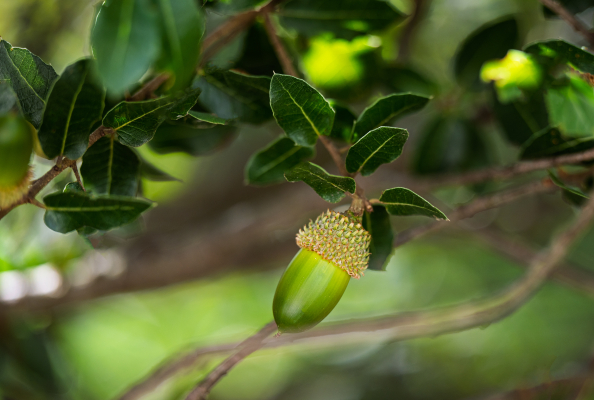
A nut is a seed contained in a hard shell which doesn’t naturally open to release the seed when it matures.
Nuts which are often mistaken for seeds are the beech mast which has four lobed cases which protect one or two triangular nuts, and the hornbeam catkin which develop into a winged fruit with a nut at the leaf base.
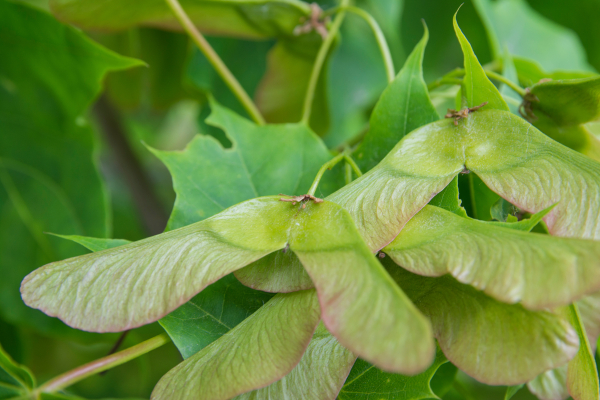
Trees that produce seeds:
Alder, ash, hawthorn, holly, lime, maple, rowan, silver birch, sycamore and willow.
Trees that produce nuts:
Beech, sweet chestnut and horse chestnut (otherwise known as conkers), hazel, hornbeam and oak (acorns).

 Meteorologist family story time