Counting and sorting pills provocation

Sort or count out the different number of pills required for your pharmacy patients.

Attention Attention

SAFETY

Before starting this activity, please make sure that the children in your setting understand:

  • If they find medicines in the form of liquids, tablets, inhalers, creams, drops, patches or syringes, they should not touch or taste them. They should immediately tell or show an adult.
  • They should only take medicines that are given to them by their parent, carer or the practitioner at their EYFS setting.
  • They should never take medicines that a doctor has prescribed for somebody else.

Early Learning Goal links

  • Mathematics: Number ELG
  • Mathematics: Numerical Patterns ELG
  • Understanding the World ELG: Past and Present
  • Understanding the World ELG: People, Culture and Communities
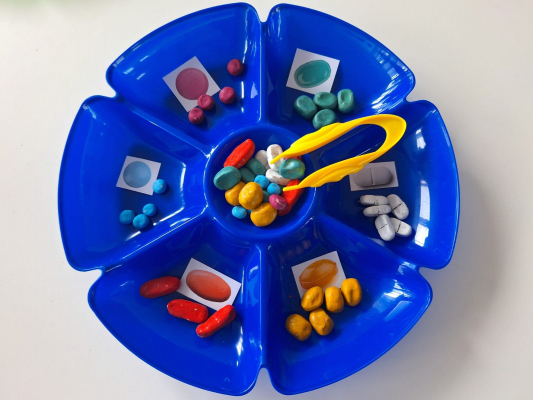
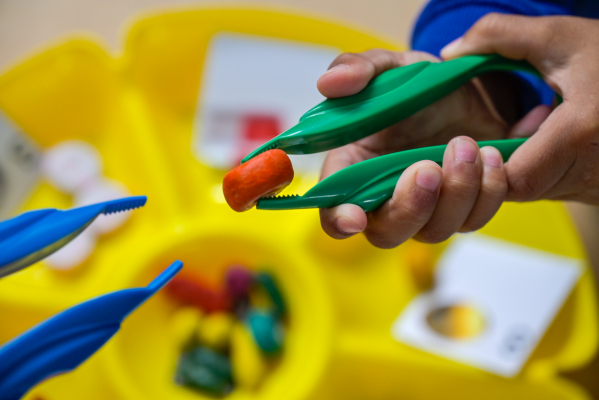
Replica clay pill held in tweezers.

Download progression document

Includes statements from Development Matters (birth to age five) and the relevant ELGs in full, for the Counting and sorting pills provocation

Characteristics of effective learning

Play, Be, C Units provide enabling environments with teaching and support from adults. Reflecting on the characteristics of effective teaching and learning, children will have opportunity to learn and develop by:

  • Playing and exploring – children investigate and experience things, and ‘have a go’.
  • Active learning – children concentrate and keep on trying if they encounter difficulties and enjoy achievements.
  • Creating and thinking critically – children have and develop their own ideas, make links between ideas, and develop strategies for doing things.

Early Years Foundation Stage Statutory Framework: accessed November 2024. Available under the Open Government Licence v3.0.

What you will need

Duration

  • 10 – 15 minutes

STEM vocabulary to introduce

Medicine, pill, tablet, capsule, lozenge, count out, sort, how many?, enough, not enough, more than, less than, the same as, equal to, shape, round, rounder, flatter, sphere, spherical, oval, subitise

What to do – before you start

Prepare your sorting trays. You will need to make or print out your pills. You might want to try our Making pills adult led activity. Depending on your focus, you could ask the children to:

A tray of pills to be sorted using tweezers to match corresponding photographs.

What to do – sorting or counting out the pills

Show the children the pharmacist poster. Remind the children that pharmacists need to prepare medication for their patients. The amount the patients will need is written on the prescription from the doctor. Tell the children that pharmacists can be very busy and might need to get the medication ready for lots of patients at once. The children will need to be observant to make sure their pills match the pills required in the sorting trays.

Remind the children that the pharmacists cannot touch the pills as their hands will have germs on them which they don’t want to get on the pills. Tell the children they will need to use the tweezers for sorting the pills.

Give each child a sorting tray and challenge them to count out the correct number or sort out the pills correctly.

You could ask:

  • Do you have the correct pills?
  • How can you tell?
  • What colour/shape/size are the pills that need to go into that section?
  • Can you describe those pills for me?
  • Do you have the correct number of pills? How do you know?
  • Which section has more/less/least/most/one more than/one less than…?

You could swap the trays, numbers or pictures ready for another turn.

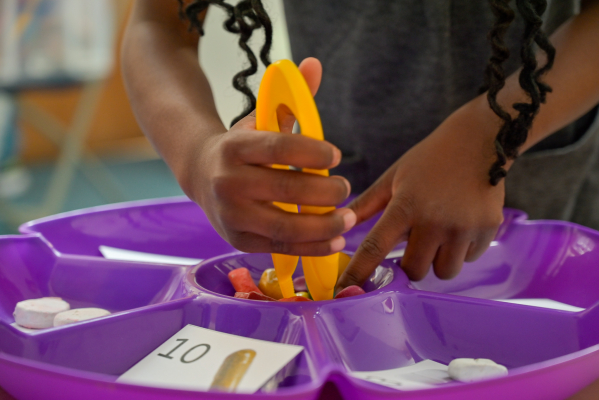
Child using tweezers to sort replica clay pills into sections of a tray labelled with the number of each pill required.

What to do – checking the counting

You could check the children have counted out the correct number of pills by asking them to count them onto a tens frame.

If you are sorting the pills, you could check how many of each pill have been sorted into each section by counting them onto the tens frame.

You could ask:

  • How many pills do you have?
  • How do you know?
  • Do you need more/less?
  • Which section has more/less/least/most/one more than/one less than…?
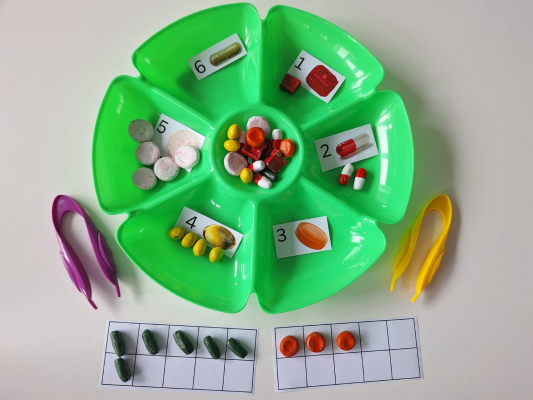
Clay pills counted and matched to given number and photograph. A set of 6 and a set of 3 pills are placed on a 10s frame.

Remember to refer to the children as pharmacists and praise them for using the attributes. You could say things like:

“You have been observant like a pharmacist and made sure your pills went into the correct sorting trays.”

The science of pharmacies

We have put together some useful information about the science of medication to accompany this activity. Don’t worry, this is for your information only and to help you answer any questions children may have. We don’t expect you to explain this to the children in your setting!

What is a medicine?

Medicines are products that contain active ingredients. An active ingredient is a chemical compound that can be used to cure, halt or prevent disease; ease symptoms; or help in the diagnosis of illness. Active ingredients may be based on molecules extracted from plants, made by a chemical reaction in a laboratory, or be the byproduct of organisms such as fungi.

Medicines may be in the form of liquids, tablets, capsules, inhalers, creams, drops and patches.

Medicines act in a variety of ways.

Antibiotics can cure an illness by killing or halting the spread of invading bacteria.

Some medicines can control problems such as high blood pressure.

Medicines like insulin can replace missing substances or corrects low levels of natural body chemicals.

Analgesics are medicines which block the pathways that transmit pain signals from the injured or irritated body part to the brain, relieving pain.

Vaccines can protect the body against some infectious diseases. They teach your body to make the correct antibodies to fight against the disease if you catch it.

What are the different types of pills?

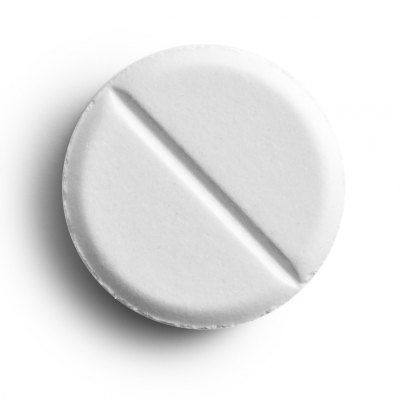
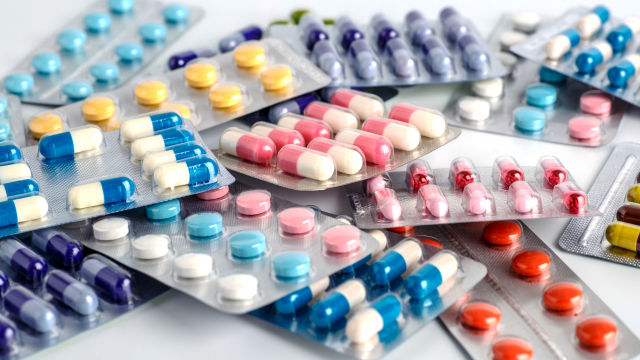
A tablet is a hard and compressed medication in a round, oval, or square shape. The active ingredient is combined other substances to make the tablet sturdy enough to be packaged and transported. Some tablets have a coating to protect against stomach acids and delay the release of the drug into the blood stream. These tablets should not be crushed or chewed. Some tablets are soluble and are designed to be dissolved in water. The active ingredient in the tablets are eventually absorbed into your bloodstream and travel around your body.
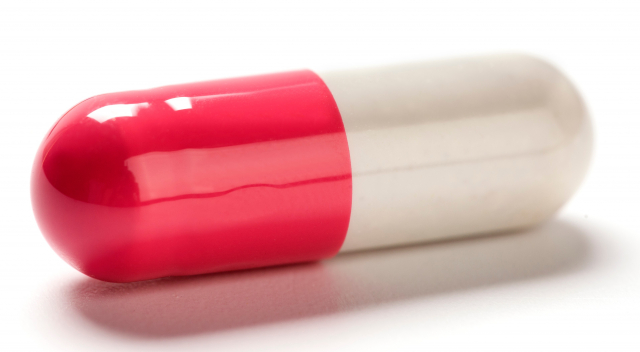
In a capsule the active ingredient is contained inside a plastic shell that dissolves slowly in the stomach. Some capsules need to be swallowed whole but others can be split open and the contents mixed with food or liquid. Capsules with a hard shell have two halves which fit inside each other to form a closed casing. They can be filled with dry or liquid ingredients, and can contain more than one active ingredient.  Some capsules have a soft-gel coating, and may be semi-transparent.  They contain medication suspended in gelatin (or similar substance) that is easily digested so the active ingredients are released and absorbed quickly.
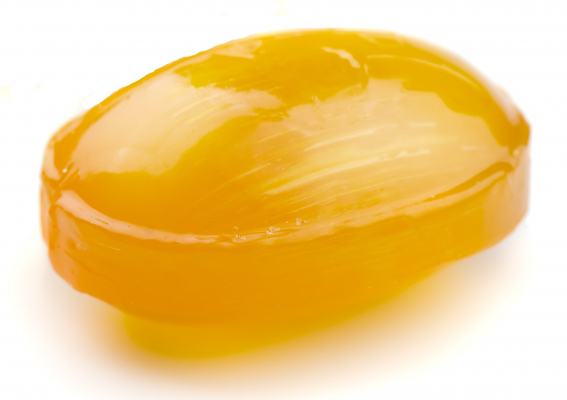
Lozenges are solid pills which are designed to dissolve slowly in the mouth. They are often flavoured and sweetened so they taste nice. They release their active ingredients slowly.  Lozenges may contain anaesthetics, antiseptics or something to soothe the throat (a demulcent). They are generally used to treat mouth or throat illnesses.

Pastilles are designed to dissolve slowly in the mouth like lozenges but are usually softer.

Suppositories are used to deliver drugs to the body when other routes cannot be used. Their active ingredient is mixed with another substance, pressed into a bullet, round, oval or cone shape, then coated with a substance such as gelatin. Suppositories are usually inserted into the rectum, and once in the body dissolves to release medication to treat the local area or travel to other parts of the body via the bloodstream.

Why are pills used more often than liquid medicines?

Pills are the most common form of medication because they are small, convenient and easy for a patient to take. Pills are often simple to manufacture, have low production costs and are easily transported and stored.

Pills can be designed to contain multiple drugs, or have different doses of the same drug in layers. This reduced the number of pills that a patient needs to take.

Blister packets of tablets and capsules.
© Northumbria University 2014-26