Making medicine water play provocation

Challenge children to mix and measure liquids to create medicines

Attention Attention

SAFETY

Before starting this activity, please make sure that the children in your setting understand:

  • If they find medicines in the form of liquids, tablets, inhalers, creams, drops, patches or syringes, they should not touch or taste them. They should immediately tell or show an adult.
  • They should only take medicines that are given to them by their parent, carer or the practitioner at their EYFS setting.
  • They should never take medicines that a doctor has prescribed for somebody else.

Early Learning Goal links

  • Mathematics: Number ELG
  • Mathematics: Numerical Patterns ELG
  • Understanding the World ELG: Past and Present
  • Understanding the World ELG: People, Culture and Communities
  • Understanding the World ELG: The Natural World
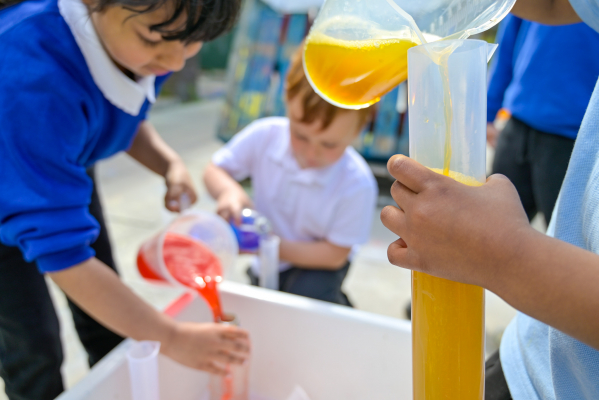
Children pouring coloured water from jugs into measuring cylinders.

Download progression document

Includes statements from Development Matters (birth to age five) and the relevant ELGs in full, for the Making medicine water play provocation

Characteristics of effective learning

Play, Be, C Units provide enabling environments with teaching and support from adults. Reflecting on the characteristics of effective teaching and learning, children will have opportunity to learn and develop by:

  • Playing and exploring – children investigate and experience things, and ‘have a go’.
  • Active learning – children concentrate and keep on trying if they encounter difficulties and enjoy achievements.
  • Creating and thinking critically – children have and develop their own ideas, make links between ideas, and develop strategies for doing things.

Early Years Foundation Stage Statutory Framework: accessed November 2024. Available under the Open Government Licence v3.0.

What you will need

Duration

  • 10  to 15 minutes

STEM vocabulary to introduce

Mixture, medicine, mixing, liquid, container, funnel, fill, pour, estimate, nearly, close to, about the same as, just over, just under, too much, too little, enough, not enough, full, empty, half, full, holds, more than, less than, the same as, equals, lighter, darker, colours, predict.

Note about language
Pencil Pencil

We recommend that you DO NOT refer to this activity as ‘making potions’. This is often linked with magic to children and so might introduce a misconception about what science is about for them.

Before you start

You may want to do the Making medicine adult led activity with the children first to introduce them to following a recipe, using containers to measure and to develop pouring skills.

To set up the provocation you will need to use the food colouring make up bottles or jugs of different coloured water. We have found that all food colourings are different, so you will need to experiment first to get an attractively coloured water that doesn’t stain!

We found that that making up about 1 litre of each colour in 500ml bottles or jugs and having 5 or 6 different colours lasts about one session.

If you are using recipe cards, you will need to make them to suit your focus for the activity or print out ours and laminate or put inside plastic wallets to ensure they last the session.

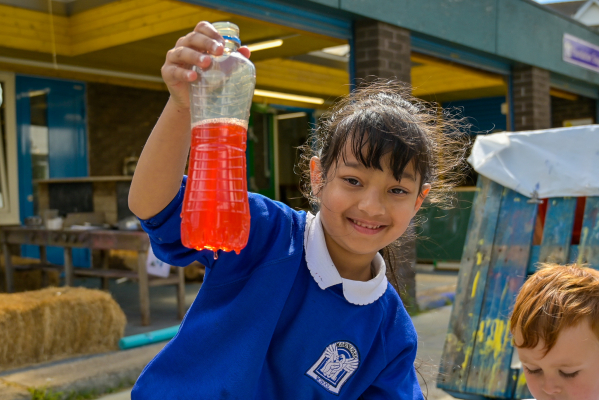
Child holding a small bottle that is two thirds filled with coloured water.

What to do

Show the children the pharmacist poster and tell them that they are going to be creative like pharmacists and make up the medicines for the patients that come into the pharmacy.

You could also tell the children that they are going to be curious like pharmacists and find out what happens when they mix different coloured ingredients together. Tell them they will need to be observant like pharmacists to notice what happens.

If you are using recipe cards, challenge the children to complete the recipe on the card and pour it into a bottle using a funnel. If you are experimenting and investigating the coloured water, challenge the children to create a medicine for you.

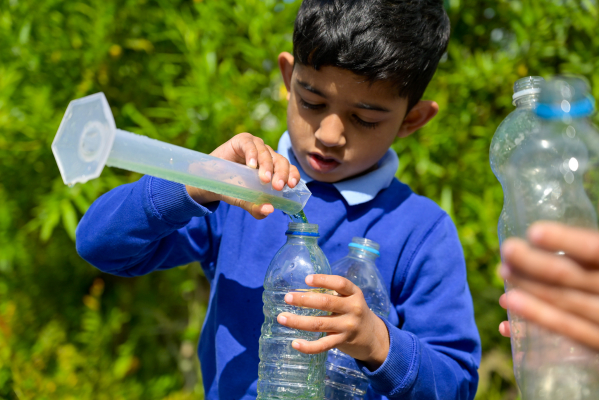
A child pouring coloured water from a measuring cylinder into a bottle.

Questions to ask to support and extend learning

  • Who is your medicine for? What is the matter with them?
  • Which colour liquids are you using?
  • What happens when you mix them together?
  • What happens if you add more blue/green/red…?
  • Which colour did you use the most/least of?
  • What do you think the red liquid does to help people get better?
  • How do you think the blue liquid helps your body?
  • Can you make me a mixture to stop my headache?
  • Can you make me a mixture to cure my sore throat?
  • How many of these (smaller) containers does it take to fill that (larger) container?
  • How many of these (smaller) bottles can you fill with that (larger) container of medicine mixture you have made?
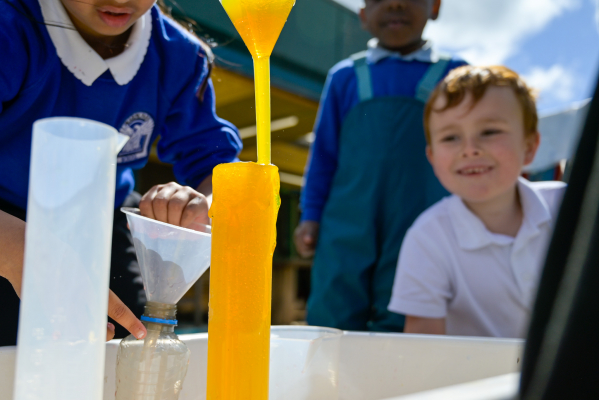
Children watching a measuring cylinder overflow as coloured water in poured into it via a funnel.

Remember to refer to the children as pharmacists and praise them for using the attributes. You could say things like:

“You have been creative like an pharmacist because you created the medicines for your patients.”

“You have been curious like a pharmacist and investigated what happened when you mixed different colours together.”

“You were observant like a pharmacist and noticed what happened.”

Other things to try

You might want to change the focus of your water play be adding different equipment.

You could use different sized bottles and spoons/containers to count out how many spoonfuls of medicine are in each bottle.

You could include pipes and syringes to develop fine motor skills, particularly if you have children in your setting or children with family members who require feeding or medical tubes.

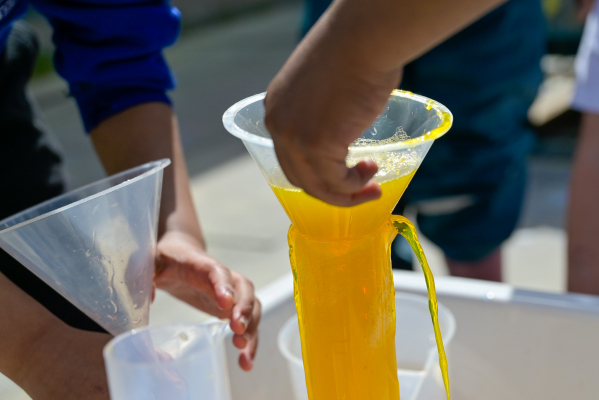
Children investigating using a measuring cylinder, funnel and coloured water.

The science of pharmacies

We have put together some useful information about the science of medication to accompany this activity. Don’t worry, this is for your information only and to help you answer any questions children may have. We don’t expect you to explain this to the children in your setting!

What is a medicine?

Medicines are products that contain active ingredients. An active ingredient is a chemical compound that can be used to cure, halt or prevent disease; ease symptoms; or help in the diagnosis of illness. Active ingredients may be based on molecules extracted from plants, made by a chemical reaction in a laboratory, or be the byproduct of organisms such as fungi.

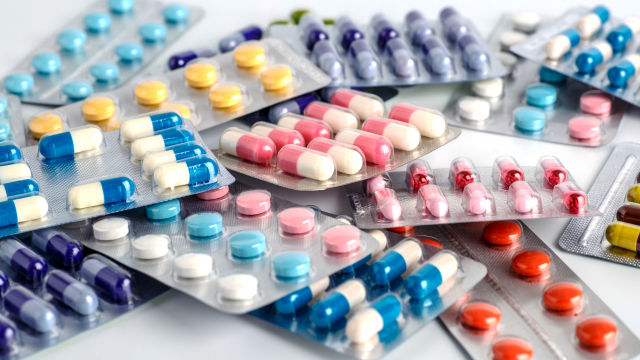
Medicines may be in the form of liquids, tablets, capsules, inhalers, creams, drops and patches.

Medicines act in a variety of ways.

Antibiotics can cure an illness by killing or halting the spread of invading bacteria.

Some medicines can control problems such as high blood pressure.

Medicines like insulin can replace missing substances or corrects low levels of natural body chemicals.

Analgesics are medicines which block the pathways that transmit pain signals from the injured or irritated body part to the brain, relieving pain.

Vaccines can protect the body against some infectious diseases. They teach your body to make the correct antibodies to fight against the disease if you catch it.

Why did our medicine change colour?

Liquid food colourings are usually made from water and a coloured dye or pigment.  The dye is dissolved in the water to make a solution. This is a physical change and not a chemical one.

When we add the liquid food colouring to the water, the food colouring spreads out throughout the mixture. Once the water and colouring are mixed together, the final liquid looks the same throughout. This is called a homogeneous solution.

We made different strength solutions by adding food colouring to different amounts of water with different. When we add more food colouring to the water, the colour becomes darker because there is more dye or pigment in the solution. When we add more water to the solution, it becomes more diluted and looks lighter.

The light we see is made up of the different colours of the spectrum, these are the colours of the rainbow. When light passes through the coloured water some of the colours of the spectrum are absorbed.  Other colours will pass through or be reflected. The colour we see is a result of which ones are not absorbed.  That means a red liquid has absorbed all of the other colours apart from red. This light reaches our eyes and we perceive the object as being red.

What are the different types of liquid medication?

Liquid medicines are mostly used for children, but may also be taken by adults who have difficulty swallowing tablets or capsules.  There are four types of liquid medicines.

An elixir is a sweet alcohol-based solutions in which active ingredients are dissolved.

A solution is a liquid containing dissolved active ingredients.

A suspension is a liquid holding undissolved particles of the active ingredient that must be shaken before taking.

A syrup has liquid active ingredients dissolved in sugar water to disguise the taste.

Why are pills used more often than liquid medicines?

Pills are the most common form of medication because they are small, convenient and easy for a patient to take. Pills are often simple to manufacture, have low production costs and are easily transported and stored.

Pills can be designed to contain multiple drugs, or have different doses of the same drug in layers. This reduced the number of pills that a patient needs to take.

Blister packets of tablets and capsules.
© Northumbria University 2014-26