Download progression document
Includes statements from Development Matters (birth to age five) and the relevant ELGs in full, for the Giant bubbles adult led activity

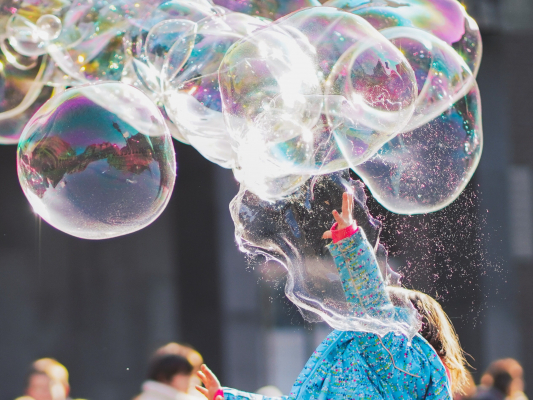
Includes statements from Development Matters (birth to age five) and the relevant ELGs in full, for the Giant bubbles adult led activity
Play, Be, C Units provide enabling environments with teaching and support from adults. Reflecting on the characteristics of effective teaching and learning, children will have opportunity to learn and develop by:
- Playing and exploring – children investigate and experience things, and ‘have a go’.
- Active learning – children concentrate and keep on trying if they encounter difficulties and enjoy achievements.
- Creating and thinking critically – children have and develop their own ideas, make links between ideas, and develop strategies for doing things.
Early Years Foundation Stage Statutory Framework: accessed November 2024. Available under the Open Government Licence v3.0.
A bubble wand
Bubble solution
Blowing the bubbles
Liquid, mixture, solution, gas, air, blow, wind, move, rise, float, sink, up, down, across, left, right, big, huge, large, enormous, round, sphere, burst, surface, inside
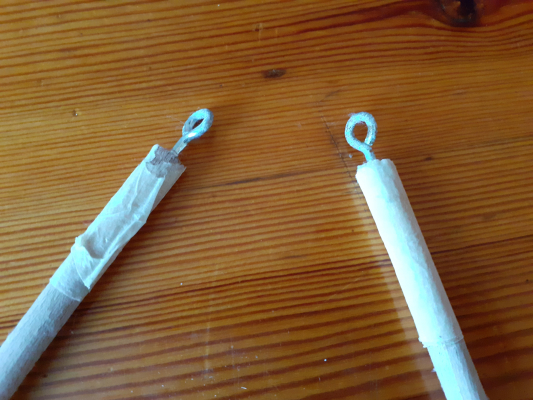
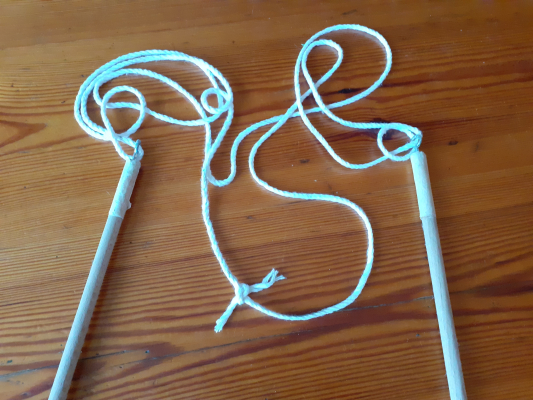
Screw the eyelet screws into the top of your sticks.
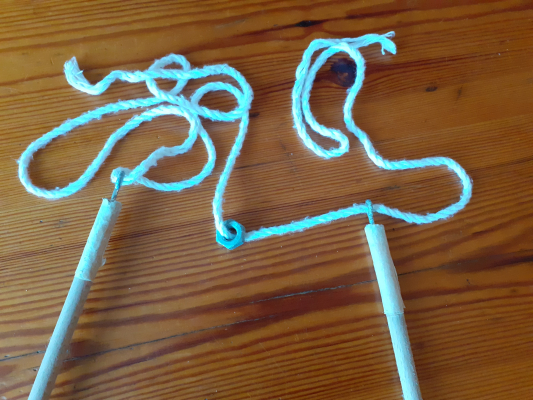
Thread the string through the eye hooks and through the washer or nut.
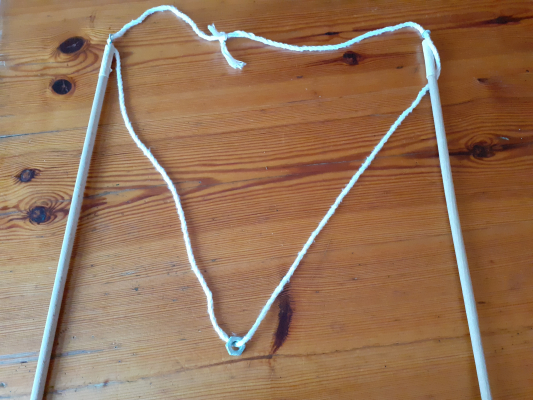
Tie a secure knot in the string to complete the circle.
Fill your bucket or container with 6 l of water.
Sieve a small amount of guar gum (less than 1/4 teaspoon) on to the top of the water. Whisk into the water.
Repeat this step until all of the guar gum is whisked into the water. You need to do this a little at a time or it will form lumps.
Sieve the bicarbonate of soda or baking powder into the water and whisk. This can be all in one go.
Pour in 300 ml of washing up liquid and stir gently with a spoon.
Show the children the fluid scientist poster and tell the children that they are going to be fluid scientists for this activity.
Ask the children if they know what a fluid scientist does. Fluid scientists are interested in what liquids, and gases are like and how they move and behave. Liquids and gases are examples of fluids
Tell the children about the attributes. Fluid scientists are:
Curious – about what different fluids can do and how they might help us.
Observant – they watch fluids carefully to see how they behave.
Resilient – they try lots of tests before they find the best uses for different fluids.
Tell the children that for this activity they are going to be curious about how big bubbles can be, they are going to observe the bubbles and they are going to be resilient, because the bubbles don’t work every time.
You could ask the children:
Dip the string into the bucket of bubble mixture. When you lift it out, carefully separate your sticks so that your string forms a triangle with the weight at the bottom.
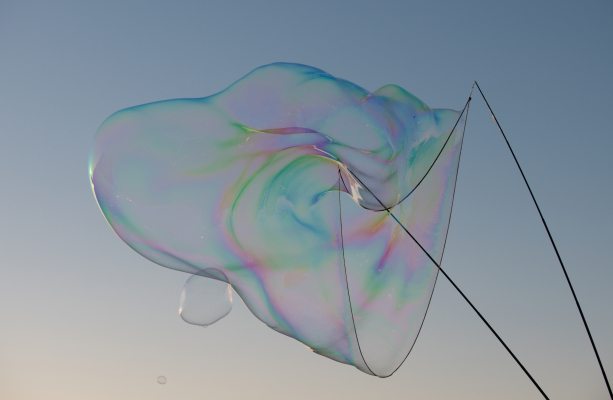
Move the wand from side to side or walk backwards to create bubbles.
You could ask:
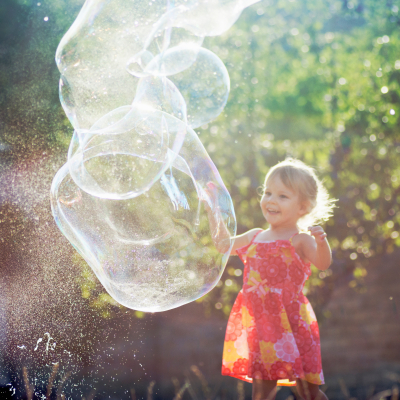
Encourage the children to take a turn at blowing bubbles. This is quite adult intensive, as the task requires concentration and well controlled fine motor skills to be successful and children need a lot of encouragement and guidance.
Remind the children that fluid scientists are resilient, and they need to keep trying if they can’t blow a bubble the first time.
Remember to refer to the children as fluid scientists and praise them for using the attributes. You could say things like:
“You were observant like a fluid scientist when you noticed the shape and size of the bubbles.”
You will need: 2 sticks about 50 cm long, 2 eyelet screws, thick string- 3 m length, thin string.
Screw the eyelet screws to the tops of the sticks and thread the cord through the eyelets, tying it without the washer this time.
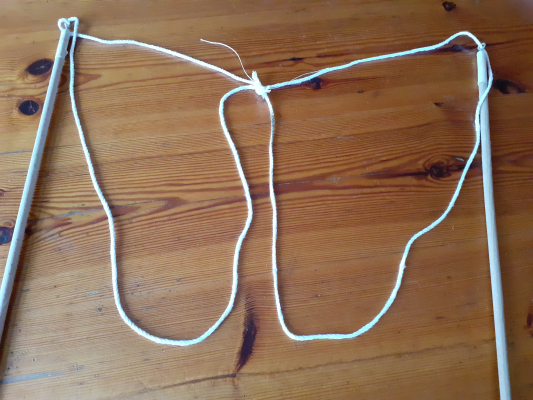
Spread out the wand in a triangle shape, and tie the bottom corner of the triangle to the centre of the top edge using some thin string.
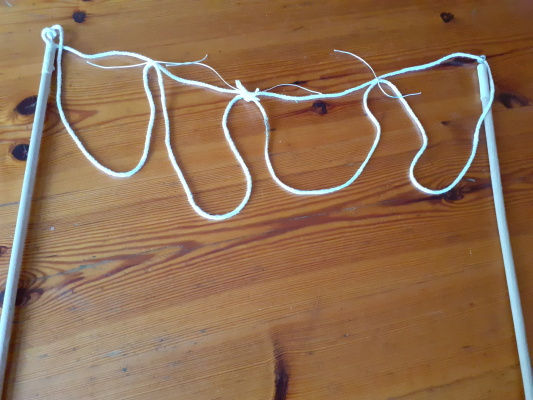
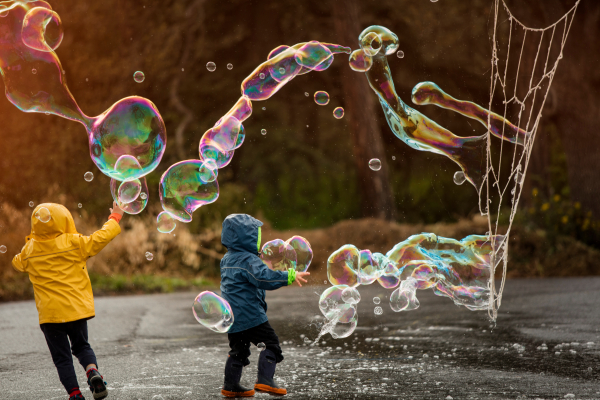
Repeat this with the two loops, turning them into four loops. You can stop there, or repeat again to make eight small loops, which is about the maximum you will fit on this length of cord.
You could experiment with tying lots of loops of string together to make a huge net-like bubble wand.
We have put together some useful information about the science of fluids to accompany this activity. Don’t worry, this is for your information only and to help you answer any questions children may have. We don’t expect you to explain this to the children in your setting!
Mixing washing-up liquid with water forms a solution. When you blow a bubble, air is trapped by a thin film of your bubble mixture. This film is made of a layer of water sandwiched between two layers of soap.
The bubbles are big because the area created by the string loop is so big! If you use a big bubble wand, the surface area and volume of the soapy film covering your bubble wand is greater than using a small bubble wand where the surface area and volume of bubble solution is less. The more bubble solution you start with, the larger the bubble you can blow.
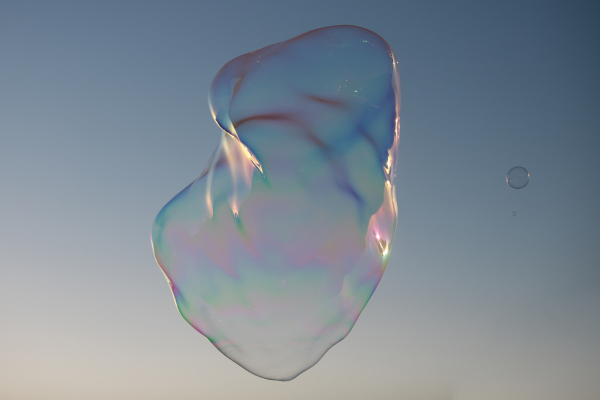
A bubble pops if the soapy outer skin is broken. This can happen as the water in the bubble evaporates, or if the bubble touches something dry or oily. It can also happen when the bubble becomes too big and there isn’t any more soap to create the sandwich layer. If your bubbles last a really long time, you might see the colours shift as the water drains around the sides of the bubble back onto the flat surface. Eventually, the bubble gets so thin you can barely see it – right before it pops by drying out!
As well as soap, giant bubbles need additives called long-chain polymers (long molecules similar to those used in plastics) in the solution. Guar gum is one of these polymers. It can stretch and let large bubbles expand, especially when they come in a variety of lengths. Too much guar gum makes the mixture overly viscous (thick and sticky) so it is too hard for the solution to expand.
Baking soda or sodium bicarbonate is naturally alkaline, with a pH of 8. When you add baking soda to water, it raises the pH and the alkalinity. When the pH is optimal, bubbles tend to be stronger, easier to close and last longer.


 Table bubbles adult led activity