Climate Change: It’s in Our Hands
Climate Science Resources

The game has been designed so that children can play in groups supported by their teachers.
Teachers can support children to extend their learning, by facilitating discussion as the game is played.
We have also put together some information about climate science to support your engagements and discussions with children about climate change.
Average temperatures across the world have shown an increasing trend since the early 20th century. This pattern has coincided with the continuous release of greenhouse gases into the atmosphere.
A famous representation of recent climate change is Ed Hawkins’ climate stripes – these show the annual global temperatures from 1850 – 2022. Red shows temperatures above-average and blue shows below-average temperatures. You can see that recent years have been far warmer than any time in the last 100 years. The rising temperatures are already having negative effects on many of our natural environments, including oceans, deserts, low-lying islands and glaciers.
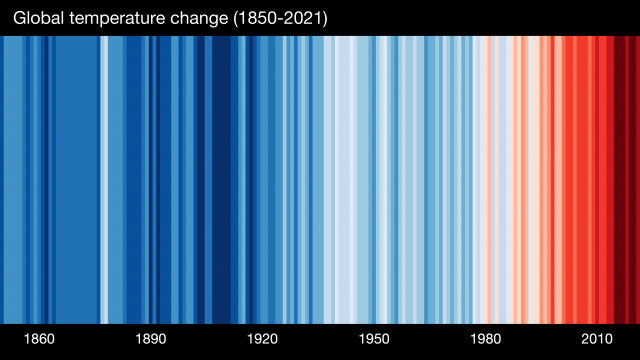
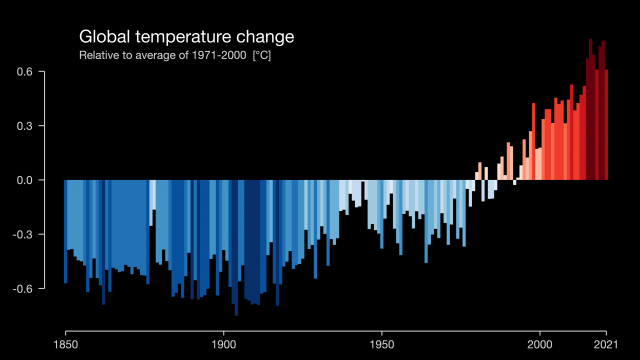
Climate Stripes from Ed Hawkins: https://showyourstripes.info/s/globe
The Paris Agreement is a legally binding international treaty on climate change, adopted by 196 countries at the United Nations Climate Change Conference (COP 21) in Paris in 2015. The goal of the Paris Agreement is to limit global warming to well below 2 degrees Celsius, preferably to 1.5 degrees, compared to pre-industrial level. To achieve this long-term temperature goal, countries aim to reach the peak of greenhouse gas emissions as soon as possible to achieve a climate neutral (net zero) world by 2050.
Scientists project that limiting warming to 1.5 degrees would reduce the worst impacts of climate change, but even with 1.5 degrees of warming, scientists predict extreme heat-waves, rising sea levels and the destruction of 70-90% of coral reefs.
As temperatures rise there is more energy in the climate system (think about a boiling pan of water compared to one at room temperature). This creates more extreme weather events (storms, droughts, floods and wildfires). Hotter temperatures also cause glaciers to melt and the water in the oceans to expand – combined this leads to rising sea level.
For biodiversity loss, the further temperature moves from “normal”, the more stressed global ecosystems become and the more likely a plant or animal cannot simply move to a new location to survive.
Climate change will continue in the years ahead. But we can all make a difference, however big or small, to take actions that slow down, as well as prepare for some of the impacts. Climate change and its impacts will vary a lot from place to place, so it’s important that action happens on all levels, from local, to regional, national and global scales. We can all take our own individual actions, but a successful future relies on collective actions of all people – all ages in the community, government, scientists and businesses.
We will not solve the climate crisis if we do nothing for 30 years, and then do everything all at once, as it will be too late. However if we invest in renewable energy early, then we might be able to slow the rise in global temperatures.
The game represents the fact that collective action early (now) will give us the greatest change of avoiding a climate crisis.
There are loads of great resources available for anyone wishing to explore climate science further, including:
Met Office – https://www.metoffice.gov.uk/weather/learn-about/met-office-for-schools/resources-for-7-11
Office for Climate Education – https://www.oce.global/en/resources
Royal Meteorological Society – https://www.metlink.org/
AntarcticGlaciers.org – https://www.antarcticglaciers.org/glaciers-and-climate/climate-change/
NASA Global Climate Change – https://climate.nasa.gov/evidence/
British Council – climate resources for school teachers – https://www.britishcouncil.org/climate-connection/get-involved/resources-school-teachers