Fluid scientist family STEM story time
Families will investigate different shapes and sizes of bubble wands and the bubbles they make.

Children’s parents, carers and other family members all help shape children’s ideas about themselves and what they should do with their lives, including what would be a suitable future job for them.
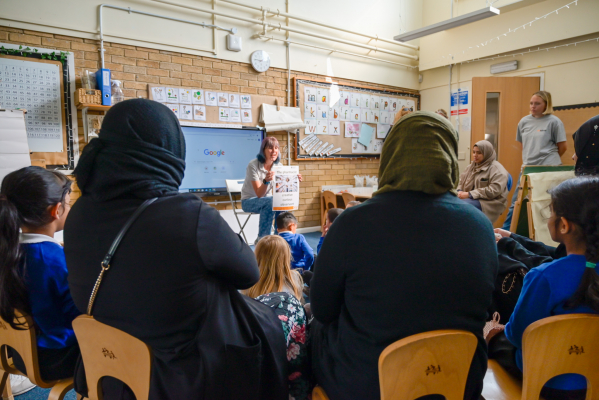
A family STEM story time is an opportunity to introduce STEM careers, ideas and activities in a relaxed and enjoyable way. STEM story time also provides an opportunity to positively model how adults and children can share stories together.
Each session begins with an introduction to a STEM career and the attributes used in the job. There is then a STEM story which introduces a STEM concept or problem to the group. The session then continues with a practical activity based on the concept introduced by the story. This is designed to be completed by an adult and a child working together. They can successfully complete the challenge together, ensuring their experience of STEM is a positive one.
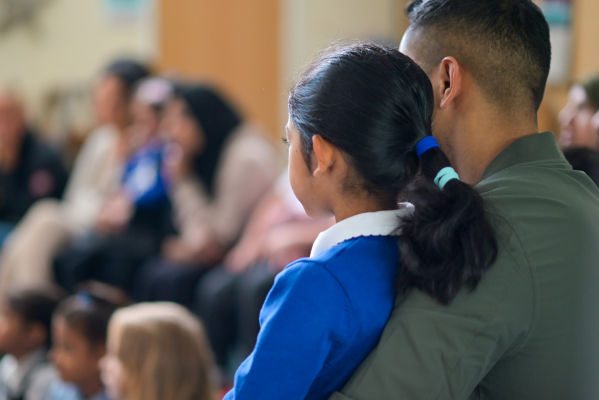
For this activity, you’ll invite children’s parents or carers into your setting, so they can work alongside each other.
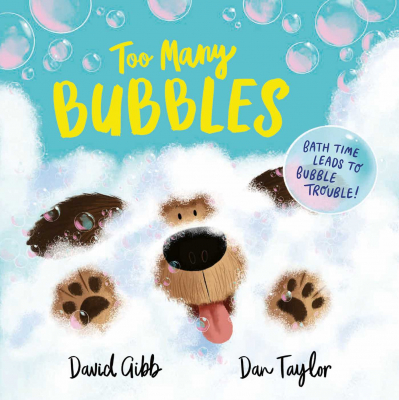
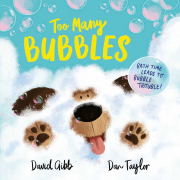
Too Many Bubbles is widely available from bookshops and education suppliers.
Fluid – a material that flows – can be a liquid or a gas.
Liquid – a material that can flow and take on the shape of the container it is in.
Gas – a material that can flow but has no fixed shape and will spread out to fill a container it is in.
Mixture – a combination of different materials.
Film – a thin layer of liquid surrounded by air.
Do these things before the session
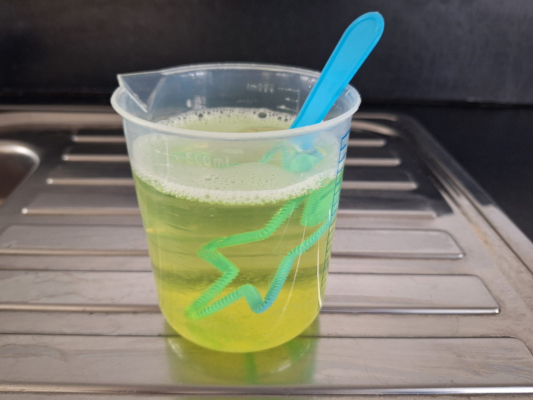
Mix washing up liquid and water – with 1/4 washing up liquid to 3/4 water.
You will need enough containers for all of the families to access so you might want to use one each. They need to be filled so that the mixture covers the bubble end of the bubble wand when it is dipped in.
You might want to start saving the bubble wands from any tubs of bubble mixture you have been using in your setting or looking for some interesting shaped bubble wands you could buy.
Think about:
If you have already had story times with your families you will know what works best in your setting, but if not you may want to consider:
Start the session by showing families the fluid scientist poster and telling them that a fluid scientist is a job that uses science. If you have already done some of the activities from the fluid scientist unit, you could ask the children to explain to their families what a fluid scientist does. If this is a new topic, you could ask the families if they know what a fluid is. A fluid is a general name for liquids and gases. You could ask the families to give you examples of liquids and gases they know. You could ask the families what sorts of things they think a fluid scientist might do.
Tell everyone that for this activity, they are going to be like fluid scientists.
You could tell the families that fluid scientists are interested in what liquids and gases are like, and how they move and behave. They can study ocean currents, weather patterns, plate tectonics and blood circulation. Their work is used in rocket engines, wind turbines, oil pipelines and air conditioning systems.
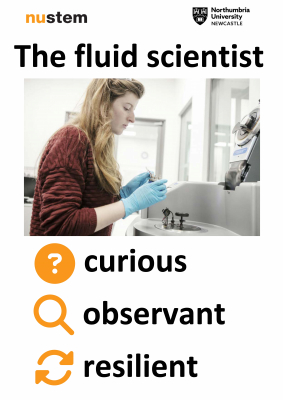
Introduce these attributes by telling the families that attributes are personal skills or qualities that we already have.
You could tell them that fluid scientists are:
Curious about what different fluids can do and how they might be used.
Observant as they watch fluids carefully to see how they behave.
Resilient when they try lots of tests before they find the best uses for different fluids.
During the activity, the children and adults might also be able to identify where they are using these attributes.
You know the families in your setting and the best way to read a story to them, but to help we have designed these STEM focused questions to use alongside the questioning you would usually use when reading a story.
After reading the story, please make sure that the children understand that they should NOT drink or taste the bubble mixture or put the bubble wands in their mouths.
Show the fluid scientist poster again and use the attributes in the activity explanation.
Tell the families that they are going to be:
Curious like fluid scientists, about the different shaped and sized bubbles you can make with different shaped and sized wands.
Observant like fluid scientists as they notice the different shapes and sizes of the bubbles.
Resilient like fluid scientists as it is quite tricky to blow bubbles, but they need to keep trying until they can do it.
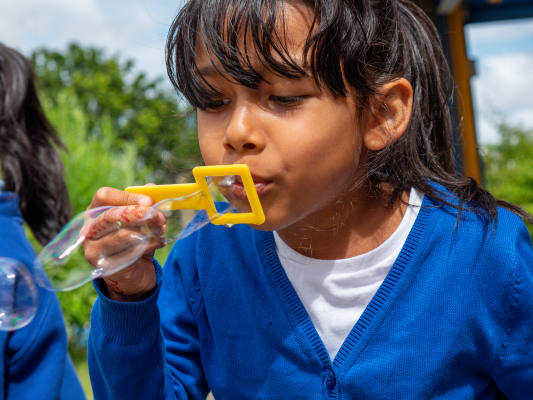
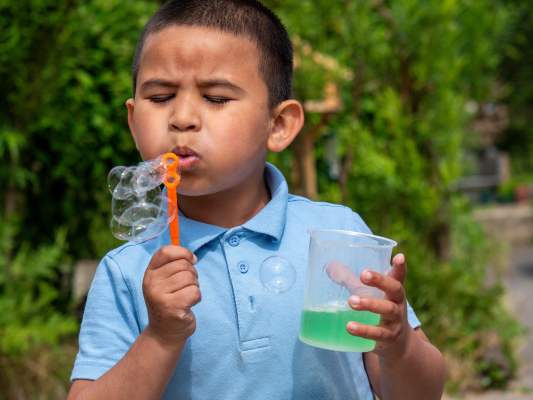
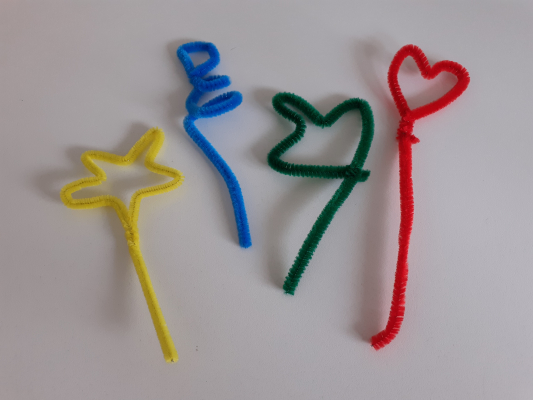
Families should take a pipe cleaner and twist one end into a looped shape to make bubbles. The loop is so that a bubble can form. When the families dip the loop into the mixture, they need to make sure that all of the loop goes in so that a bubble film forms across the loop. Then they need to blow gently to create a bubble.
You might want to show the families some examples of bubble wands and ask them to predict what shape or size bubble the wand will make. You could discuss why they think this.
Remind children not to taste or drink the bubble mixture and not to put any of the equipment in their mouths.
While the families are busy investigating bubbles, you could ask them:
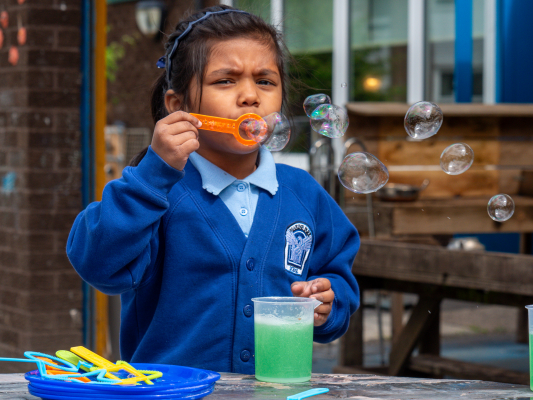
When the families have completed their investigations, you could discuss what they observed. You could ask if the different shaped bubble wands did make different shaped bubbles, and discuss which wands made bigger and smaller bubbles.
Remind the families of the attributes: being curious about the different shaped and sized bubbles they can make, observant when they noticed the different shapes and sizes of the bubbles and resilient as it is quite tricky to blow bubbles, but they kept on trying until they did it.
There is a STEM at home activity linked to this activity that families can try. It includes an indoor bubbles activity, more STEM careers information and other activities for the whole family to try at home.
You could tell the families that if they have enjoyed today’s activity, maybe they could be fluid scientists in the future.
This section is for your information. It’s intended to be useful background – you’re welcome to include it in the session, but we expect you’d more commonly draw on it when children or their families have questions.
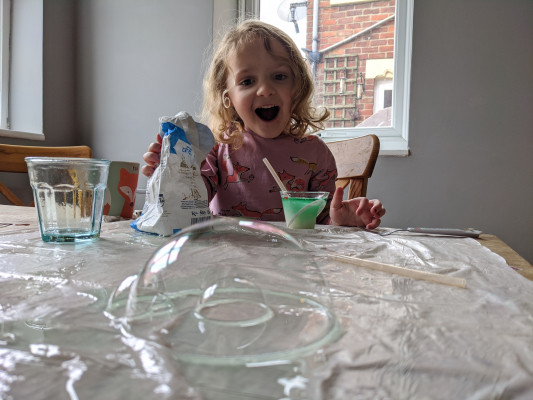
Mixing washing-up liquid with water forms a solution. When you dip your wand into the solution, a flat film is formed across the bubble wand. This is made up of a layer of water sandwiched between two layers of soap. The flat surface has the smallest possible surface area.
When you start blowing air in that soapy film, the liquid soapy skin starts to stretch and air is trapped by a thin film of the bubble solution. This increases the surface tension or tightness of the film, and it tries to shrink the bubble into a shape with the smallest surface area for the volume of air inside it – which is always a sphere.
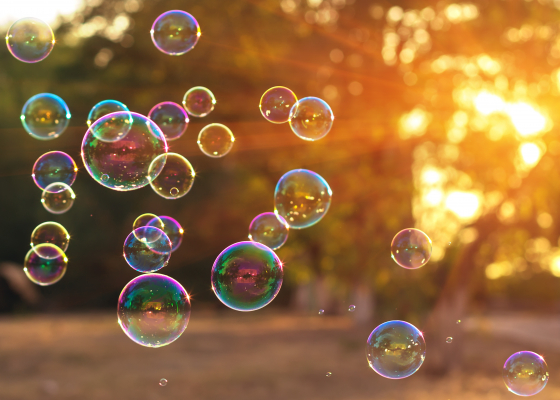
The more bubble solution you start with, the larger the bubble you can blow. So if you use a big bubble wand, the surface area and volume of the soapy film covering your bubble wand is greater than using a small bubble wand and the bubbles will be bigger.
A bubble pops when the soapy outer skin breaks. This can happen as the water in the bubble evaporates, or if the bubble touches something dry or oily. It can also happen when the bubble becomes too big and there isn’t any more soap to create the sandwich layer.
If your bubbles last a really long time, you might see the colours shift as the water drains around the sides of the bubble back onto the flat surface. Eventually, the bubble gets so thin you can barely see it – right before it pops.


 Robotics engineer family story time